Upper Arms Exercise · Smith Machine And A Secure Intended Decline Bench With Leg Restraint
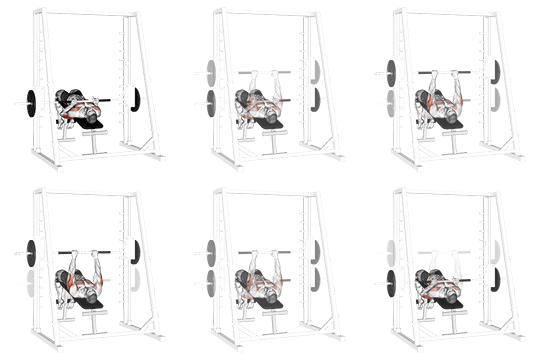
Smith Machine Decline Close Grip Bench Press
Press with a comfortable close overhand grip while the head and back rest on a decline bench and the legs stay in its designed restraint. Keep the adjustment locked and check the hooks, stops and guided path before loading. This is still a press with both shoulders and elbows moving.
Go to the movement steps- Category
- Upper Arms
- Equipment
- Smith Machine And A Secure Intended Decline Bench With Leg Restraint
- Movement focus
- Decline close-grip press with restrained legs
Exercise reference published by PlanWorkouts; see our editorial standards.
How to Do the Smith Machine Decline Close Grip Bench Press
- Follow the actual machine and bench instructions for this exercise. Before adding plates, establish the bench position and a controllable bar path with gym-staff help if needed. Set and check the adjustable stops and reachable hook positions for your chosen range; starting bar resistance varies.
- Secure an intended decline bench and its leg restraint before getting under the bar. Establish head, back and pelvis support with the legs held by the bench rather than planted on the floor.
- Use a comfortable close overhand grip with both thumbs wrapped and the wrists supported.
- Take the bar off its hooks using the actual machine procedure, with a trained spotter helping as needed. Keep a firm thumb-wrapped grip and steady wrists throughout; do not change your grip under load.
- Lower toward the chest through a comfortable elbow path. Keep the support contacts steady and do not pin the upper arms immobile against the torso.
- Pause briefly at the lower endpoint you can control without forcing chest contact or a fixed clearance.
- Press back along the rails under control without forcing an elbow lock.
- At the end, control the bar into a reachable rack position using the machine procedure. Confirm both hooks are fully engaged before releasing your hands, leaving the bench or changing any adjustment.
Hooks, stops and support
The rail does not make every bar height a rack position. Check the actual hooks and adjustable stops before use and obtain gym-staff instruction if their operation is unclear. The illustrated model is unidentified; another model’s starting resistance, load limit or hook-rotation direction does not transfer automatically.
Range and load
Keep the head, back and pelvis supported and use a load and range you can control. Do not force chest contact, a fixed distance above the chest or an elbow lock. Do not bounce the bar or rely on the machine as a guarantee of safety without a spotter. Stop if pain develops.
Technique references: Muscle & Strength: close-grip Smith press; Muscle & Strength: decline close-grip bench components; Muscle & Strength: decline Smith press; Life Fitness: hook engagement and adjustable-stop example, manual pages 2–3. Muscle & Strength supplies close-grip pressing and pad-restrained decline bench components; its decline Smith source supplies the guided press. These components do not prove exclusive triceps work or heavier-load safety. Follow the actual bench restraint and machine operation.
Technique & Form Tips
The close grip changes hand spacing while both shoulders and elbows move. The restrained legs remain supported through the lower and return; elbow tucking does not turn the chest off.
Common Mistakes to Avoid
- Elbow path: Adjust the angle of your upper arms to find a comfortable position for your shoulders.
- Using momentum: Control the descent and ascent to focus on steady movement.
How to Breathe During This Exercise
Exhale during the pushing phase and inhale during the return.
Comfort and Control
Stop if the movement causes pain. If you have an existing condition, ask a qualified professional about an appropriate exercise and range.
General guidance: Mayo Clinic on weight-training technique. Follow the specific movement steps above for this variation.
Community questions about this movement
For questions and discussions, visit the workout community. Community posts are separate from this exercise guide.