Upper Arms Exercise · Two Dumbbells And Stable Flat Bench
Dumbbell Neutral Grip Bench Press
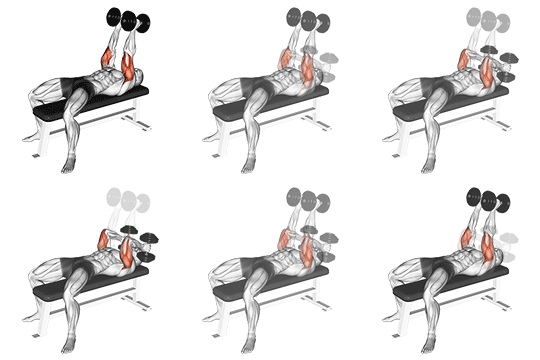
The illustration shows a lying elbow extension: the upper arms stay raised while the forearms fold and the weights lower beside the head. That differs from a neutral-grip bench press, where the upper arms move toward the chest. The page name and illustration need alignment before this can be a complete exercise guide.
View setup and limitsAlso known as: Db Neutral Grip Bench Press, Dumbell Neutral Grip Bench Press
- Category
- Upper Arms
- Equipment
- Two Dumbbells And Stable Flat Bench
- Movement focus
- Reference: lying elbow extension shown under a bench-press name
Exercise reference published by PlanWorkouts; see our editorial standards.
Demonstration Setup and Limits
- The illustrated person lies supported on a flat bench with a dumbbell in each hand and the arms raised.
- The forearms fold while the upper arms stay fairly steady; the weights move beside the head rather than down to the chest.
- The elbows straighten to return the weights upward. No contact with the head, fixed numerical angle or loaded entry and exit is established by the loop.
Reference limits
Confirm whether the intended exercise is a bench press or a lying elbow extension. Until the name and illustration agree, use this page only to identify the visible motion.
Technique references: Muscle & Strength: lying dumbbell extension; Muscle & Strength: neutral-grip flat dumbbell press. The original lying-extension guide and neutral flat-press guide describe different elbow and shoulder paths. They support distinguishing the illustrated extension from a bench press; they do not establish which name or asset was intended for this address.
Technique & Form Tips
Elbow extension is the defining visible motion here. Calling that motion a chest press would give conflicting instructions for the animation.
Common Mistakes to Avoid
How to Breathe During This Exercise
Exhale during the pushing phase and inhale during the return.
Comfort and Control
Stop if the movement causes pain. If you have an existing condition, ask a qualified professional about an appropriate exercise and range.
General guidance: Mayo Clinic on weight-training technique. Follow the specific movement steps above for this variation.
Community questions about this movement
For questions and discussions, visit the workout community. Community posts are separate from this exercise guide.