Upper Arms Exercise · Dumbbell
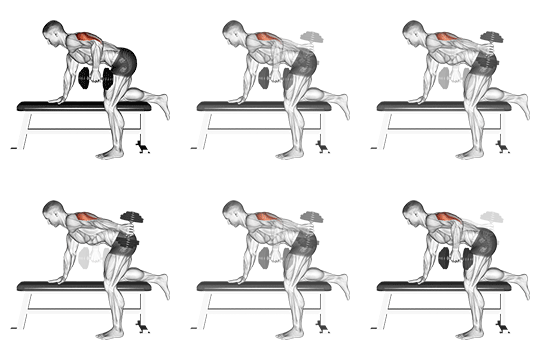
Dumbbell Kickback
The kickback isolates the triceps at full elbow extension, a position most pressing movements skip past quickly on the way to lockout. Keeping the upper arm parallel to the floor and stationary is what makes this a triceps isolation exercise rather than a shoulder one — letting the upper arm drop turns it into something else entirely. It's a lighter-weight finisher, not a strength builder, since the leverage at full extension is poor for handling real load.
Go to the movement stepsAlso known as: Db Kickback, Dumbell Kickback
- Category
- Upper Arms
- Equipment
- Dumbbell
- Target
- Triceps
Exercise reference published by PlanWorkouts; see our editorial standards.
How to Do the Dumbbell Kickback
- Take a shoulder-width stance holding a dumbbell in each hand.
- Soften your knees and fold forward from your hips, keeping your spine straight.
- Pin your upper arms against your sides with your elbows bent to about 90 degrees.
- Straighten your arms backward, contracting your triceps at full extension.
- Hold briefly, then bring the dumbbells back down slowly to the start.
- Continue for the set reps, taking care to lower with control and reset your posture between each rep.
Quick Exercise Facts
Recommended Sets & Reps by Goal
Moderate weight · 60s rest
Lighter weight · 30–45s rest
Lower slowly for 3 seconds · 60s rest
Technique & Form Tips
Focus on controlled elbow extension while keeping your upper arms fixed in the position required by your specific variation, such as a pushdown or overhead extension. Manage your range of motion based on your own comfort during both flexion and extension.
Common Mistakes to Avoid
- Elbow migration: Keep the upper arm stationary to prevent the movement from turning into a different exercise.
- Inconsistent elbow tracking: Follow the intended path for your elbows to ensure they do not excessively flare outward.
- Forcing the end position: Straighten and bend the elbow through a controlled, comfortable range without snapping into the end position.
How to Breathe During This Exercise
Breathe continuously, matching your inhale and exhale to the pace of your repetitions.
Add the Dumbbell Kickback to Your Custom Workout Routine
Build a personalized, science-backed workout plan matching your training goals, equipment access, and schedule.
Comfort and Control
Choose a load and range you can control. Stop if the movement causes pain. If discomfort persists, stop and ask a qualified professional about an appropriate exercise and range.
General guidance: Mayo Clinic on weight-training technique. Follow the specific movement steps above for this variation.
Muscles Worked
The Dumbbell Kickback mainly targets your Triceps, with your Shoulders helping support the movement.
More Upper Arms Exercises
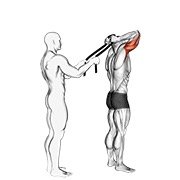 Assisted Standing Triceps Extension (with Towel)
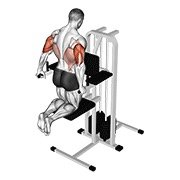 Assisted Triceps Dip (kneeling)
 Band Alternating Biceps Curl
 Band Close-Grip Push-Up
 Band Concentration Curl
 Band One Arm Overhead Biceps Curl
More Triceps Exercises
 Band Side Triceps Extension
 Barbell Close-Grip Bench Press
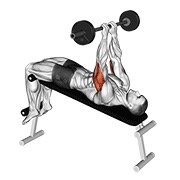 Barbell Decline Close Grip To Skull Press
 Barbell Incline Close Grip Bench Press
 Barbell Incline Reverse-Grip Press
 Barbell Jm Bench Press
Equipment Alternatives
Don't have dumbbell? These target the same triceps with different equipment.
 Body-Up
Band Side Triceps Extension
Barbell Decline Close Grip To Skull Press
 Cable Alternate Triceps Extension
FAQ
- What muscles does the Dumbbell Kickback work?
- The Dumbbell Kickback mainly works your triceps. Your shoulders also works to help support and steady your body. Using good, smooth form makes sure you work the right muscles and avoid unnecessary strain on your joints.
- What equipment do I need for the Dumbbell Kickback?
- You do the Dumbbell Kickback with a dumbbell. Make sure your equipment is set up safely before starting. If you work out at home or have limited gear, check out our alternative exercises below.
- What form mistake should I watch for on the Dumbbell Kickback?
- One mistake to watch for is elbow migration: Keep the upper arm stationary to prevent the movement from turning into a different exercise.. Use a comfortable range and a controlled return; reduce the load if you cannot maintain the demonstrated setup.
- How many sets and reps should I perform on the Dumbbell Kickback?
- To tone and grow muscle, do 3 to 4 sets of 10 to 15 smooth reps with 60 seconds of rest, focusing on a full stretch and squeezing the muscle at the top of each rep.
- What's a good alternative to the Dumbbell Kickback?
- The Body-Up trains your triceps with body weight and a similar movement pattern. Review its form guide before substituting it, since setup and range of motion can differ.