Lower Legs Exercise · Stable Bench And Nonslip Forefoot Support
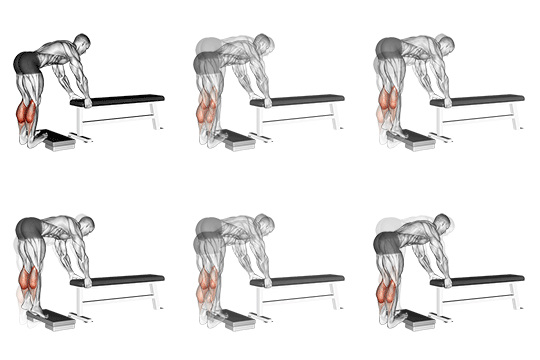
Donkey Calf Raise
Hinge forward and rest the hands on a stable bench while both forefeet stay on a raised support. Keep that body position as the heels rise and lower through a comfortable range; the pictured version has no partner or added back load.
Go to the movement steps- Category
- Lower Legs
- Equipment
- Stable Bench And Nonslip Forefoot Support
- Movement focus
- Bodyweight donkey heel raise with a fixed hip hinge and hands on a bench
Exercise reference published by PlanWorkouts; see our editorial standards.
How to Do the Donkey Calf Raise
- Stand with the balls of your feet on a raised surface, such as a step or block.
- Hinge at the hips and place both hands on a stable bench in front of you. Keep secure forefoot contact and a comfortable, steady back position.
- Raise both heels through a comfortable range without straightening up or pushing the hips forward.
- Hold briefly at the top, then slowly lower your heels back to the starting position.
- Repeat for your planned rep target, maintaining clean technique and steady breathing on every repetition.
Unloaded version
The linked donkey guide includes external back loading; only its supported hinge and heel-motion components apply here. Do not add a partner or loose plate to copy that different variation.
Technique references: JEFIT: donkey calf raise components, loaded version differs. The demonstration identifies this pictured variation. Original written sources support the specified components, with setup differences stated explicitly; no original testing, muscle-recruitment comparison or health benefit is claimed.
Technique & Form Tips
The hip hinge is held while movement occurs at the ankles. The loop does not show a partner, plate on the back or repeated hip extension.
Common Mistakes to Avoid
- Straightening the torso during the lift: Keep the supported hinge steady and move the heels rather than standing upright on each repetition.
How to Breathe During This Exercise
Breathe rhythmically throughout the lift.
Comfort and Control
Stop if the movement causes pain. If you have an existing condition, ask a qualified professional about an appropriate exercise and range.
General guidance: Mayo Clinic on weight-training technique. Follow the specific movement steps above for this variation.
Community questions about this movement
For questions and discussions, visit the workout community. Community posts are separate from this exercise guide.