Upper Arms Exercise · Barbell, Stable Flat Bench And Trained Assistance
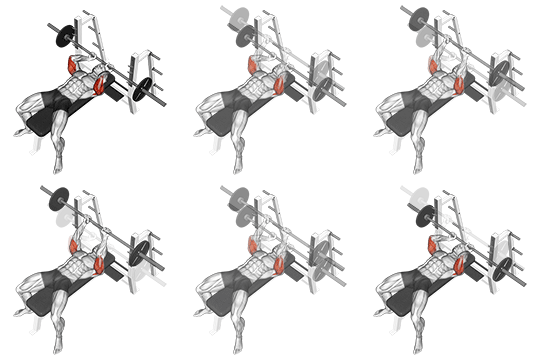
Barbell Lying Extension
This loop bends the elbows to lower the bar toward the forehead, then straightens them to return above the upper body. The upper arms remain relatively steady compared with the behind-head extension variants. It is an elbow-extension reference, not a close-grip chest press or a claim of greater overall growth than pressing.
Go to the movement stepsAlso known as: Bb Lying Extension
- Category
- Upper Arms
- Equipment
- Barbell, Stable Flat Bench And Trained Assistance
- Movement focus
- Forehead-endpoint lying elbow extension
Exercise reference published by PlanWorkouts; see our editorial standards.
How to Do the Barbell Lying Extension
- Agree on a controlled handoff and return with a trained partner. Have qualified staff teach the full handling before using a loaded bar near the head.
- Lie on a bench with your feet flat on the floor and your head near the end of the bench.
- Keep the head, upper back and buttocks supported. Use an even overhand grip around shoulder width, adjusted to controlled wrists and elbows, with the thumbs wrapped around the bar.
- With assistance as needed, settle the bar above the upper body before starting the lowering phase.
- With your upper arms held still, slowly bend your elbows to lower the barbell toward your forehead.
- Treat held still as relatively steady, not a forced joint position. Keep the bar clear of the head and stop at a range you control; there is no required inch measurement, head contact or maximal stretch.
- Pause briefly, then straighten your arms back to the starting position.
- Repeat only while the lowering and return remain controlled. Do not turn the motion into a chest press or a large shoulder swing.
- Use the agreed assisted return at the end, confirming that the bar is securely supported before releasing the hands.
Preserve the useful elbow-extension steps
The original controlled forehead descent and return fit this loop. The rack drawn behind the bench does not demonstrate a full liftoff or rerack; learn those transfers separately with qualified assistance.
Growth research has limits
A trial in 43 young men compared bench press, lying triceps press and combinations. Its abstract reports different responses among triceps regions but no observed between-group difference in overall triceps cross-sectional-area change. That does not establish a universal growth advantage for this particular forehead-endpoint version or prove a range-of-motion explanation.
Technique references: ACE original lying-barbell-extension grip and elbow-control teaching; Muscle & Strength original forehead-endpoint extension instruction; Breaking Muscle original partner-assisted starting setup; Brandao and colleagues2020 primary trial abstract, PMID32149887. Use qualified instruction for handoff and return. Choose grip spacing, range and load for control rather than a prescribed forehead distance. The cited trial abstract does not verify this animation’s exact setup, injury risk or comparative growth mechanism.
Technique & Form Tips
The elbows bend and straighten while the upper arms stay relatively steady. Chest pressing also involves the triceps but has a different shoulder and bar path. This animation cannot determine which exercise produces more muscle growth for an individual.
Common Mistakes to Avoid
- Forcing the end position: Straighten and bend the elbow through a controlled, comfortable range without snapping into the end position.
- Letting the bar approach the face without control: Use manageable resistance and keep clearance throughout. End the set while you can still control the return and handoff.
- Using a behind-head cue for a forehead-endpoint task: Check the actual path. A version with greater upper-arm movement has different instructions, even when it shares a lying-extension name.
How to Breathe During This Exercise
Breathe continuously, matching your inhale and exhale to the pace of your repetitions.
Comfort and Control
Stop if the movement causes pain. If you have an existing condition, ask a qualified professional about an appropriate exercise and range.
General guidance: Mayo Clinic on weight-training technique. Follow the specific movement steps above for this variation.
Community questions about this movement
For questions and discussions, visit the workout community. Community posts are separate from this exercise guide.