Upper Arms Exercise · Two Dumbbells And An Incline Bench; Exact Outward-Path Setup Not Established
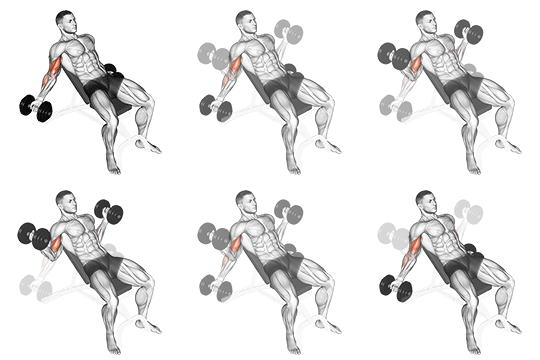
Dumbbell Incline Inner Biceps Curl
The arms open outward beside the reclining torso and both forearms curl upward. The weights travel beside the body rather than inward across its midline. The name “inner biceps curl” does not establish selective biceps-head growth.
View setup and limitsAlso known as: Dumbbell Incline Inner Bicep Curl, Db Incline Inner Biceps Curl, Dumbell Incline Inner Biceps Curl
- Category
- Upper Arms
- Equipment
- Two Dumbbells And An Incline Bench; Exact Outward-Path Setup Not Established
- Movement focus
- Reference: outward curl path with a reclining backrest
Exercise reference published by PlanWorkouts; see our editorial standards.
Demonstration Setup and Limits
- The back remains on a reclining pad while both forearms rise on outward paths beside the body.
- The weights return beside the bench. The loop does not establish a required shoulder-opening angle or a complete setup for this outward version.
Reference limit
A matching original outward-path setup, comfortable shoulder position and controlled entry/exit remain unconfirmed. Use this as a movement reference rather than a complete outward-curl protocol.
Technique references: Muscle & Strength: original bilateral incline dumbbell curl. Muscle & Strength describes an ordinary bilateral incline curl. That is a comparison for the back support and elbow movement; it does not establish a complete setup or shoulder-opening range for this outward-path version.
Technique & Form Tips
The visible path differs from a straight-ahead bilateral incline curl. It is not an inward cross-body motion or evidence that the inner biceps is isolated.
Common Mistakes to Avoid
- Changing the shown support or path: Do not brace the upper arms against the backrest, force the shoulders outward or use the “inner” label as a reason to chase a peak squeeze.
How to Breathe During This Exercise
Breathe steadily throughout the movement, ideally exhaling during the contraction phase.
Comfort and Control
Stop if the movement causes pain. If you have an existing condition, ask a qualified professional about an appropriate exercise and range.
General guidance: Mayo Clinic on weight-training technique. Follow the specific movement steps above for this variation.
Community questions about this movement
For questions and discussions, visit the workout community. Community posts are separate from this exercise guide.