Upper Arms Exercise · Barbell
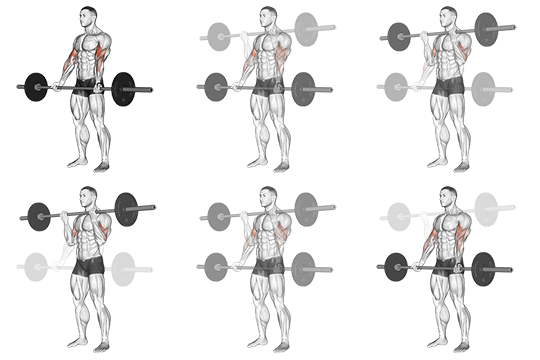
Barbell Curl
This standing curl uses both hands under one straight bar, with the upper arms near the torso as the elbows bend and straighten. The bar rises in an arc from the thighs toward the upper body. The shared bar keeps the hands linked, but its travel is controlled by the lifter rather than a rail or fixed machine path.
Go to the movement stepsAlso known as: Bb Curl
- Category
- Upper Arms
- Equipment
- Barbell
- Target
- Biceps
Exercise reference published by PlanWorkouts; see our editorial standards.
How to Do the Barbell Curl
- Inspect the bar, plates and collars and plan how to collect and return the bar before loading. Use a light practice load and a stable support or a taught pickup/set-down method; ask qualified staff if that handling is unfamiliar.
- Stand upright with your feet shoulder-width apart, gripping a barbell underhand with your palms facing forward.
- Choose an even comfortable hand spacing around shoulder width with a secure grip and controlled wrists. Begin with the bar in front of the thighs, the trunk steady and the elbows near the sides.
- Bend the elbows to raise the bar in a smooth arc without throwing the hips forward or leaning back. Keep the upper arms relatively steady rather than forcing them rigidly against the ribs.
- Stop at a height you can control without shrugging, forcing wrist extension or lifting the shoulders to chase a mandatory shoulder-height finish. Pause briefly if comfortable.
- Inhale as you slowly lower the bar back to the starting position.
- Finish while control remains, support the bar using the planned return method, and release it only once it is securely supported.
Hand linkage and bar travel are different
The two hands share a straight bar, while the elbows and shoulders still control its travel. The image establishes neither equal left/right loading nor a mechanically fixed path.
Keep the curl variations distinct
ACE describes an underhand curl with the elbows near the body and a still chest. The arm-blaster version adds an upper-arm support; the drag curl lets the elbows travel backward to keep the bar close. Those are different setups rather than one universal elbow cue.
Technique references: ACE original standing barbell-curl instructions. Two-hand underhand grip, a free curl arc, steady standing support and controlled return are observed. Exact grip/range/load, limb-force equality, wrist tolerance and comparative training or clinical outcomes remain unverified; no external video was watched.
Technique & Form Tips
Elbow bending raises the bar and elbow straightening lowers it. Both hands share one bar, but the picture does not measure equal effort from each arm or constant biceps force through the arc. A straight bar limits independent hand rotation; whether it feels more or less comfortable than another grip depends on the person and setup.
Common Mistakes to Avoid
- Treating a free bar as a fixed track: Control the arc with a steady trunk and comfortable wrists; the bar does not guide itself.
- Forcing a prescribed top height: Use a controlled comfortable elbow range rather than shrugging or leaning to reach the shoulders.
- Swinging or dropping the return: Keep the torso steady and lower smoothly; choose less load if you cannot do that.
How to Breathe During This Exercise
Breathe steadily throughout the movement, ideally exhaling during the contraction phase.
Comfort and Control
Stop if the movement causes pain. If you have an existing condition, ask a qualified professional about an appropriate exercise and range.
General guidance: Mayo Clinic on weight-training technique. Follow the specific movement steps above for this variation.
Featured in Curated Workouts
Train the Barbell Curl with structured progression in these complete workout routines:


Community questions about this movement
For questions and discussions, visit the workout community. Community posts are separate from this exercise guide.