Upper Arms Exercise · Dumbbell
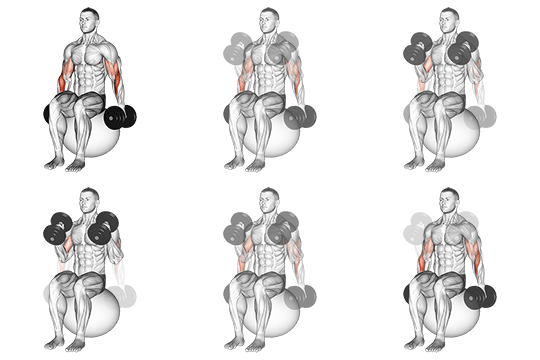
Dumbbell Hammer Curl On Exercise Ball
Also known as: Db Hammer Curl On Exercise Ball, Dumbell Hammer Curl On Exercise Ball
- Category
- Upper Arms
- Equipment
- Dumbbell
- Target
- Biceps
Biomechanical cues verified by the PlanWorkouts Science Review Board under CSCS editorial oversight; see our editorial standards.
The Dumbbell Hammer Curl On Exercise Ball is a targeted isolation upper arms movement designed to train the Biceps.
Single-joint elbow flexion isolated in the sagittal plane. Focuses mechanical load on biceps brachii (long and short heads) and brachialis with minimal torso swinging. Executing this with strict form maximizes muscle fiber recruitment while protecting joint structures.
Quick Exercise Facts
Target Muscle Activation
Sitting or kneeling on a stability ball for hammer curls adds a mild core and balance requirement to an otherwise simple neutral-grip curl. The hammer grip itself still does the main job of working the brachialis and forearm alongside the biceps. Keep the weight modest — the ball is there for variety and light stability training, not for progressive overload.
How to Do the Dumbbell Hammer Curl On Exercise Ball
- Sit on an exercise ball with feet flat on the floor and back upright.
- Hold a dumbbell in each hand, palms facing your body, arms fully extended.
- With your upper arms held still, exhale and curl the dumbbells as your biceps contract.
- Keep lifting until your biceps are fully squeezed and the dumbbells reach shoulder height.
- Pause briefly in the contracted position, squeezing your biceps.
- Inhale and slowly lower the dumbbells back down to the start.
- Continue for the prescribed repetitions while maintaining full control through both the lift and lower phases.
Recommended Sets & Reps by Training Goal
65–75% 1RM · 60s rest
50–60% 1RM · 30–45s rest
Controlled 3s eccentric · 60s rest
Biomechanical & Joint Load Cues
Single-joint elbow flexion isolated in the sagittal plane. Focuses mechanical load on biceps brachii (long and short heads) and brachialis with minimal torso swinging.
Common Mechanical Mistakes & Form Errors to Avoid
- Swinging Hips & Lower Back: Using momentum from the hips to swing the weight upward eliminates the initial concentric overload on the biceps.
- Drifting Elbows Forward: Allowing elbows to travel forward past the ribs recruits the anterior deltoids and takes tension off the biceps apex.
- Dropping the Eccentric Phase: Letting the weight fall quickly without resistance wastes 50% of the muscle-building stimulus from eccentric microtrauma.
Proper Breathing Patterns & Core Engagement
Inhale on controlled lowering (2-3s eccentric); exhale on elbow contraction to peak tension.
Add the Dumbbell Hammer Curl On Exercise Ball to Your Custom Workout Routine
Build a personalized, science-backed workout plan matching your training goals, equipment access, and schedule.
Injury Modification & Joint Safety
Lifters with distal biceps tendinopathy or golfer's elbow (medial epicondylitis) should use neutral-grip hammer curls or EZ-bars to reduce wrist pronation torque. If joint irritation persists, immediately stop and substitute this movement with another exercise from the Upper Arms exercises category.
Muscles Worked
The Dumbbell Hammer Curl On Exercise Ball primarily targets the Biceps, with Forearms as the primary synergist muscle group.
More Upper Arms Exercises
 Assisted Standing Triceps Extension (with Towel)
 Assisted Triceps Dip (kneeling)
 Band Alternating Biceps Curl
 Band Close-Grip Push-Up
 Band Concentration Curl
 Band One Arm Overhead Biceps Curl
More Biceps Exercises
 Barbell Alternate Biceps Curl
 Barbell Biceps Curl (with Arm Blaster)
 Barbell Curl
 Barbell Drag Curl
 Barbell Lying Preacher Curl
 Barbell Preacher Curl
Equipment Alternatives
Don't have dumbbell? These target the same biceps with different equipment.
 Biceps Leg Concentration Curl
Barbell Alternate Biceps Curl
Biceps Leg Concentration Curl
Barbell Alternate Biceps Curl
 Cable Close Grip Curl
 EZ Bar Seated Close Grip Concentration Curl
FAQ
- What muscles does the Dumbbell Hammer Curl On Exercise Ball work?
- The Dumbbell Hammer Curl On Exercise Ball primarily targets the biceps as the primary agonist. The forearms acts as the primary supporting muscle group during force transmission. Maintaining strict biomechanical alignment ensures maximal tension remains focused on the intended muscle fibers rather than shifting to surrounding stabilizer joints.
- What equipment do I need for the Dumbbell Hammer Curl On Exercise Ball?
- The Dumbbell Hammer Curl On Exercise Ball is performed using a dumbbell. Ensure all equipment is securely positioned with collars or safety pins locked before loading working sets. If you train in a home gym or minimal setup, explore our equipment-free and resistance band alternatives below.
- What is the most common form mistake on the Dumbbell Hammer Curl On Exercise Ball?
- The most frequent error is swinging hips & lower back: Using momentum from the hips to swing the weight upward eliminates the initial concentric overload on the biceps.. Controlling the 2 to 3-second eccentric lowering phase ensures maximal hypertrophic stimulus while shielding connective tissue.
- How many sets and reps should I perform on the Dumbbell Hammer Curl On Exercise Ball?
- For muscle growth and density, execute 3 to 4 working sets of 10 to 15 controlled repetitions with 60 seconds rest, emphasizing a deep stretch and deliberate peak contraction on every rep.
- What's a good alternative to the Dumbbell Hammer Curl On Exercise Ball?
- If you don't have access to a dumbbell, the Biceps Leg Concentration Curl targets the same biceps using body weight instead. This alternative replicates the same joint angle and movement plane while allowing you to train effectively with different available gear. You can also substitute it seamlessly in our free Workout Plan Builder.