Upper Arms Exercise · Two Dumbbells And An Exercise Ball Approved For The Specific Weighted Use
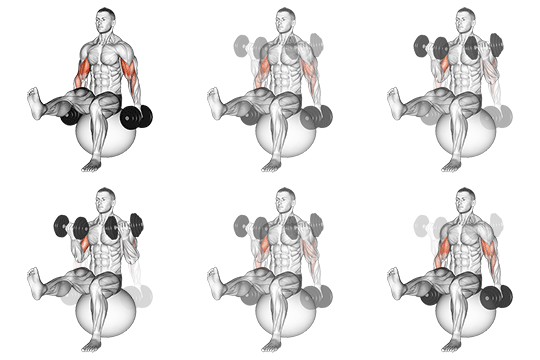
Dumbbell Bicep Curl On Exercise Ball With Leg Raised
Both dumbbells curl together while the person sits on a ball with one leg extended forward. The raised leg distinguishes this loop from an ordinary two-foot seated curl. The demonstration does not establish a safe personal loading or balance progression.
View setup and limitsAlso known as: Db Bicep Curl On Exercise Ball With Leg Raised, Dumbell Bicep Curl On Exercise Ball With Leg Raised
- Category
- Upper Arms
- Equipment
- Two Dumbbells And An Exercise Ball Approved For The Specific Weighted Use
- Movement focus
- Reference: simultaneous ball curls with one leg raised
Exercise reference published by PlanWorkouts; see our editorial standards.
Demonstration Setup and Limits
- The hips remain seated on the ball, with one foot on the floor and the other leg lifted forward.
- Both forearms rise and lower together, rather than alternating.
- Entry, weight pickup and exit from the raised-leg position are not shown.
Equipment approval
Use a ball only if its manufacturer permits this weighted exercise and your combined body-and-weight load. Follow its sizing, inflation, condition and surface instructions. A bodyweight-only ball is unsuitable; use a stable seat instead when approval or balance is uncertain.
What remains unresolved
Primary evidence for this simultaneous weighted raised-leg ball setup, including entry, balance support and exit, remains unavailable.
Technique references: Kevin Wilk: Advanced Thrower’s Ten, page 5 exercise 9A; Mayo Clinic: original biceps curl transcript; Perform Better: model-specific stability-ball use warning, catalogue page 7. Wilk 9A and Mayo corroborate ordinary seated curl components only. Neither supplies the illustrated raised-leg protocol or establishes that balance rather than the arms will limit a particular person.
Technique & Form Tips
Elbow flexion is visible, but the support arrangement requires further verification before using this as a complete practice guide.
Common Mistakes to Avoid
- Treating the reference as a complete setup: Do not copy the loaded reduced-support position from a looping animation. Use an appropriately supported seated alternative when this setup has not been established for you.
How to Breathe During This Exercise
Breathe steadily throughout the movement, ideally exhaling during the contraction phase.
Comfort and Control
Stop if the movement causes pain. If you have an existing condition, ask a qualified professional about an appropriate exercise and range.
General guidance: Mayo Clinic on weight-training technique. Follow the specific movement steps above for this variation.
Community questions about this movement
For questions and discussions, visit the workout community. Community posts are separate from this exercise guide.