Upper Arms Exercise · Two Dumbbells And An Exercise Ball Approved For The Specific Weighted Use
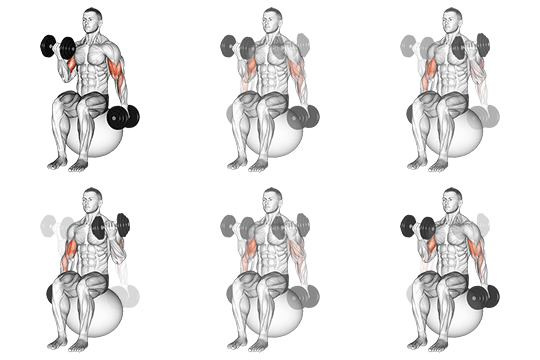
Dumbbell Alternating Seated Bicep Curl On Exercise Ball
Sit on the ball with both feet planted and alternate the dumbbells. One arm curls while the other returns beside the body. Keep the ball and torso steady rather than deliberately shifting them to create a balance challenge.
Go to the movement stepsAlso known as: Db Alternating Seated Bicep Curl On Exercise Ball, Dumbell Alternating Seated Bicep Curl On Exercise Ball
- Category
- Upper Arms
- Equipment
- Two Dumbbells And An Exercise Ball Approved For The Specific Weighted Use
- Movement focus
- Alternating seated curls on a ball with both feet supported
Exercise reference published by PlanWorkouts; see our editorial standards.
How to Do the Dumbbell Alternating Seated Bicep Curl On Exercise Ball
- Check the ball’s approval for weighted use and establish a stable seated position before taking the dumbbells.
- Sit on an exercise ball with your feet flat on the floor and your back upright.
- Hold a dumbbell beside each hip with a comfortable grip and aligned wrists.
- Alternate the arms in a controlled reciprocal motion: one dumbbell rises as the other lowers. Turn the rising palm upward only as comfortably available without bending the wrist.
- Keep alternating arms for the desired number of repetitions.
Equipment approval
Use a ball only if its manufacturer permits this weighted exercise and your combined body-and-weight load. Follow its sizing, inflation, condition and surface instructions. A bodyweight-only ball is unsuitable; use a stable seat instead when approval or balance is uncertain.
Practice and progression
Keep both feet securely supported for these seated instructions. Use a controllable load and comfortable elbow range, keep wrists aligned with the forearms and lower smoothly. Stop before the ball rolls, the torso swings or pain develops.
Technique references: Kevin Wilk: Advanced Thrower’s Ten, page 5 exercise 9A; Mayo Clinic: original biceps curl transcript; Perform Better: model-specific stability-ball use warning, catalogue page 7. Wilk 9A supplies seated-ball elbow flexion and an inward-to-upward hand turn; its feet are cropped out. Mayo allows seated and alternating curls. The local loop supplies the two-foot contact and reciprocal crossover timing. A conventional finish-one-curl-then-switch sequence is a different timing option, not this loop. No compulsory rotation angle or clinical dose is imported.
Technique & Form Tips
One elbow bends as the other arm returns beside the body. The seated ball and two supported feet define the setup; forearm rotation comes from a comfortable hand turn rather than bending the wrist.
Common Mistakes to Avoid
- Losing the shown support or hand position: Do not rock the ball, swing the torso, force a fixed shoulder-height endpoint or bend the wrists to finish a curl.
How to Breathe During This Exercise
Breathe steadily throughout the movement, ideally exhaling during the contraction phase.
Comfort and Control
Stop if the movement causes pain. If you have an existing condition, ask a qualified professional about an appropriate exercise and range.
General guidance: Mayo Clinic on weight-training technique. Follow the specific movement steps above for this variation.
Community questions about this movement
For questions and discussions, visit the workout community. Community posts are separate from this exercise guide.