Upper Arms Exercise · Low Cable Pulley And Suitable Bar Attachment
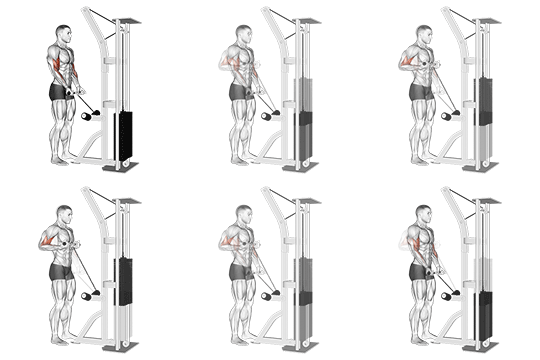
Cable Drag Curl
Raise the bar close to the torso while the elbows travel backward, then reverse the path under control. That backward elbow travel distinguishes the drag curl from a fixed-upper-arm curl. Keep the bar near the body without forcing it to rub the skin.
Go to the movement steps- Category
- Upper Arms
- Equipment
- Low Cable Pulley And Suitable Bar Attachment
- Movement focus
- Low-cable drag curl with the elbows moving backward
Exercise reference published by PlanWorkouts; see our editorial standards.
How to Do the Cable Drag Curl
- Attach a suitable bar securely to a low pulley and choose a light load. Stand close enough for a clear near-body path without contacting the machine.
- Stand facing a cable machine with your feet shoulder-width apart.
- Take an underhand grip with the bar in front of the thighs and the wrists controlled.
- Curl upward near the torso while allowing the elbows to move backward. Keep the torso steady rather than leaning back to lift the bar.
- Stop at a comfortable height and lower the bar along the same near-body path. Contact with the torso is not required.
- Continue for the set reps, taking care to lower with control and reset your posture between each rep.
Match this variation
Allow controlled backward elbow travel and keep the bar near, rather than pressed against, the torso.
Technique references: Muscle & Strength: exact cable drag-curl instructions. The linked original coaching supports the stated setup and movement. Hand spacing, machine fit and comfortable range remain individual.
Technique & Form Tips
The upper arms move backward as the elbows bend. Holding them fixed would remove the defining drag-curl action shown here.
Common Mistakes to Avoid
- Changing this variation: Do not freeze the upper arms as in a standard curl or use mandatory skin contact as proof that the movement is correct.
- Losing control of the return: Lower smoothly without letting the stack slam or pulling the body out of position. Stop if the movement causes pain.
How to Breathe During This Exercise
Breathe comfortably through the movement and pause to reset if control is lost.
Comfort and Control
Stop if the movement causes pain. If you have an existing condition, ask a qualified professional about an appropriate exercise and range.
General guidance: Mayo Clinic on weight-training technique. Follow the specific movement steps above for this variation.
Community questions about this movement
For questions and discussions, visit the workout community. Community posts are separate from this exercise guide.