Cardio Exercise · Body Weight
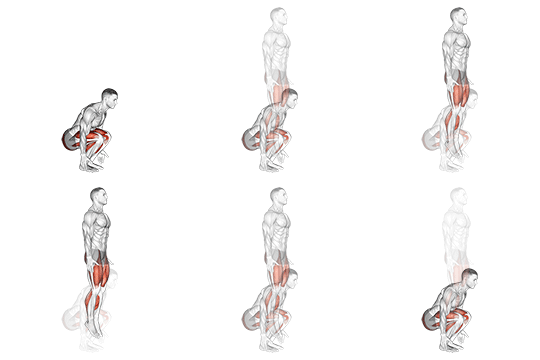
Semi Squat Jump (male)
- Category
- Cardio
- Equipment
- Body Weight
- Target
- Cardiovascular System
Form and technique verified by certified strength coaches; see our editorial standards.
The Semi Squat Jump (male) is a multi-muscle cardio exercise designed to train your Cardiovascular System with help from your Hamstrings, Calves.
Operates primarily in the sagittal plane involving knee flexion/extension and hip extension. Peak mechanical tension occurs in the deep lengthened position at the bottom transition. Maintain midfoot balance and an upright torso angle. Doing this with controlled form helps you build muscle safely while protecting your joints.
Quick Exercise Facts
Target Muscle Activation
The semi squat jump keeps the dip shallow before driving up into a jump, which shifts the emphasis toward speed and rate of force development rather than the range of motion a full squat jump would demand. It's a plyometric conditioning move, not a strength builder, so the goal is quick, springy reps rather than grinding through fatigue. Land soft through the knees to keep the joints happy over repeated sets.
How to Do the Semi Squat Jump (male)
- Begin standing with your feet shoulder-width apart.
- Bend your knees to drop into a squat position.
- Explode upward by extending your hips and knees, swinging your arms to generate momentum.
- Land gently on the balls of your feet and move directly into your next rep.
- Repeat for your desired repetitions, keeping constant tension on the working muscle throughout.
Recommended Sets & Reps by Goal
Medium weight · 90–120s rest
Heavy weight · 2–3 min rest (Calc 1RM)
Light weight · 45–60s rest
Technique & Form Tips
Operates primarily in the sagittal plane involving knee flexion/extension and hip extension. Peak mechanical tension occurs in the deep lengthened position at the bottom transition. Maintain midfoot balance and an upright torso angle.
Common Mistakes to Avoid
- Knee Valgus (Inward Collapse): Allowing knees to cave inward during the ascent places excessive tensile stress on the MCL and lateral meniscus. Drive knees out in line with second toes.
- Excessive Forward Pitch: Allowing the chest to drop and hips to shoot up turns the squat into a good-morning, transferring load off the quadriceps onto the lumbar erectors.
- Heel Lift & Weight Shift: Shifting balance forward onto the balls of the feet compromises stability and increases patellar tendon strain. Keep weight distributed over midfoot.
How to Breathe During This Exercise
Perform a deep abdominal brace (Valsalva maneuver) into the diaphragm before initiating descent. Hold intra-abdominal pressure through the bottom transition, exhaling past the sticking point on ascent.
Add the Semi Squat Jump (male) to Your Custom Workout Routine
Build a personalized, science-backed workout plan matching your training goals, equipment access, and schedule.
Comfort & Joint Safety Tips
Lifters experiencing acute patellofemoral knee discomfort should moderate depth to parallel or utilize box squats to reduce peak anterior patellar shear. If joint irritation persists, immediately stop and substitute this movement with another exercise from the Cardio exercises category.
Muscles Worked
The Semi Squat Jump (male) mainly targets your Cardiovascular System, with your Quadriceps helping support the movement, along with your Hamstrings, Calves.
More Cardio Exercises


More Cardiovascular System Exercises
 Half Knee Bends (male)
 High Knee Against Wall
 Jack Burpee
 Jack Jump (male)
 Jump Rope
 Mountain Climber
Equipment Alternatives
Don't have body weight? These target the same cardiovascular system with different equipment.


FAQ
- What muscles does the Semi Squat Jump (male) work?
- The Semi Squat Jump (male) mainly works your cardiovascular system. It also helps strengthen your quadriceps and hamstrings, calves. Using good, smooth form makes sure you work the right muscles and avoid unnecessary strain on your joints.
- What equipment do I need for the Semi Squat Jump (male)?
- You do the Semi Squat Jump (male) with no equipment — just body weight. Make sure your equipment is set up safely before starting. If you work out at home or have limited gear, check out our alternative exercises below.
- What is the most common form mistake on the Semi Squat Jump (male)?
- The most common mistake is knee valgus (inward collapse): Allowing knees to cave inward during the ascent places excessive tensile stress on the MCL and lateral meniscus. Drive knees out in line with second toes.. Lowering the weight slowly (about 2 to 3 seconds) builds more muscle and keeps your joints safe.
- How many sets and reps should I perform on the Semi Squat Jump (male)?
- To build muscle size, aim for 3 to 4 sets of 8 to 12 reps with 90 to 120 seconds of rest. To build pure strength, focus on 4 to 5 sets of 3 to 6 heavier reps with 2 to 3 minutes of rest.
- What's a good alternative to the Semi Squat Jump (male)?
- If you don't have access to the space or setup it needs, the Jump Rope targets the same cardiovascular system using rope instead. This alternative replicates the same joint angle and movement plane while allowing you to train effectively with different available gear. You can also substitute it seamlessly in our free Workout Plan Builder.