Cardio Exercise · Body Weight
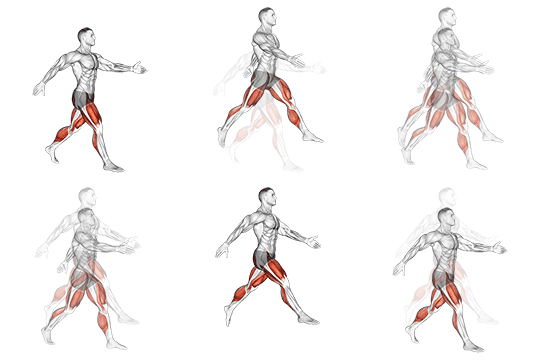
Scissor Jumps (male)
- Category
- Cardio
- Equipment
- Body Weight
- Target
- Cardiovascular System
Form and technique verified by certified strength coaches; see our editorial standards.
The Scissor Jumps (male) is a focused cardio exercise designed to train your Cardiovascular System with help from your Hamstrings, Calves.
Controlled plane of motion engaging target synergist muscle groups. Focus on deliberate eccentric control (2-3s) and active range of motion. Doing this with controlled form helps you build muscle safely while protecting your joints.
Quick Exercise Facts
Target Muscle Activation
Scissor jumps are a plyometric lunge — you're switching legs mid-air rather than stepping through, which adds an explosive, reactive demand on the quads and hip flexors that a standard walking lunge doesn't have. The landing is the part that matters most: absorbing it through a bent knee protects the joints and keeps the movement from turning into a bouncing mess. It's a conditioning tool as much as a leg exercise.
How to Do the Scissor Jumps (male)
- Begin standing with your feet shoulder-width apart.
- Jump upward while crossing your right leg in front of your left.
- Upon landing, swiftly switch so your left leg crosses in front of your right.
- Keep alternating legs, jumping as fast as you can.
- Repeat for your planned rep target, maintaining clean technique and steady breathing on every repetition.
Recommended Sets & Reps by Goal
Moderate weight · 60s rest
Lighter weight · 30–45s rest
Lower slowly for 3 seconds · 60s rest
Technique & Form Tips
Controlled plane of motion engaging target synergist muscle groups. Focus on deliberate eccentric control (2-3s) and active range of motion.
Common Mistakes to Avoid
- Uncontrolled Lifting Tempo: Rushing through reps without establishing mind-muscle connection or eccentric control reduces muscle fiber tension.
- Spine Hyperextension: Compensating for limited joint range of motion by arching the lower back risks spinal facet strain.
- Unstable Foot Base: Poor foot position causing balance loss during movement execution creates energy leaks and injury risk.
How to Breathe During This Exercise
Inhale during eccentric lowering phase; exhale during concentric work phase.
Add the Scissor Jumps (male) to Your Custom Workout Routine
Build a personalized, science-backed workout plan matching your training goals, equipment access, and schedule.
Comfort & Joint Safety Tips
Stop immediately if movement causes sharp joint or tendon pain; substitute with a joint-friendly variant. If joint irritation persists, immediately stop and substitute this movement with another exercise from the Cardio exercises category.
Muscles Worked
The Scissor Jumps (male) mainly targets your Cardiovascular System, with your Quadriceps helping support the movement, along with your Hamstrings, Calves.
More Cardio Exercises


More Cardiovascular System Exercises
 Half Knee Bends (male)
 High Knee Against Wall
 Jack Burpee
 Jack Jump (male)
 Jump Rope
 Mountain Climber
Equipment Alternatives
Don't have body weight? These target the same cardiovascular system with different equipment.


FAQ
- What muscles does the Scissor Jumps (male) work?
- The Scissor Jumps (male) mainly works your cardiovascular system. It also helps strengthen your quadriceps and hamstrings, calves. Using good, smooth form makes sure you work the right muscles and avoid unnecessary strain on your joints.
- What equipment do I need for the Scissor Jumps (male)?
- You do the Scissor Jumps (male) with no equipment — just body weight. Make sure your equipment is set up safely before starting. If you work out at home or have limited gear, check out our alternative exercises below.
- What is the most common form mistake on the Scissor Jumps (male)?
- The most common mistake is uncontrolled lifting tempo: Rushing through reps without establishing mind-muscle connection or eccentric control reduces muscle fiber tension.. Lowering the weight slowly (about 2 to 3 seconds) builds more muscle and keeps your joints safe.
- How many sets and reps should I perform on the Scissor Jumps (male)?
- To tone and grow muscle, do 3 to 4 sets of 10 to 15 smooth reps with 60 seconds of rest, focusing on a full stretch and squeezing the muscle at the top of each rep.
- What's a good alternative to the Scissor Jumps (male)?
- If you don't have access to the space or setup it needs, the Jump Rope targets the same cardiovascular system using rope instead. This alternative replicates the same joint angle and movement plane while allowing you to train effectively with different available gear. You can also substitute it seamlessly in our free Workout Plan Builder.