Chest Exercise · Two Dumbbells And A Suitable Stability Ball
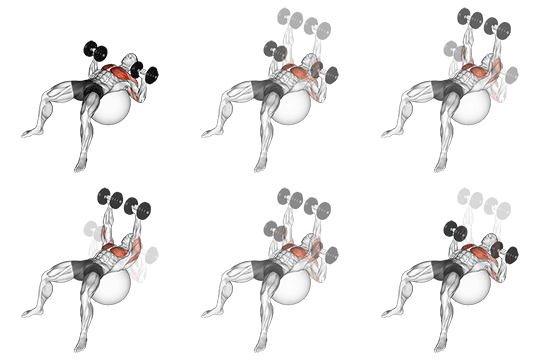
Dumbbell Press On Exercise Ball
Press both dumbbells from beside the chest while your upper back is supported on the ball and both feet stay planted. Bend the elbows on the return and keep the torso steady. Establish the reclined support before pressing; a lower-back support endpoint is insufficient.
Go to the movement stepsAlso known as: Db Press On Exercise Ball, Dumbell Press On Exercise Ball
- Category
- Chest
- Equipment
- Two Dumbbells And A Suitable Stability Ball
- Movement focus
- Two-weight reclined press with upper-back ball support
Exercise reference published by PlanWorkouts; see our editorial standards.
How to Do the Dumbbell Press On Exercise Ball
- Use a ball whose manufacturer permits this weighted exercise and the combined body and dumbbell load. Follow its inflation and inspection instructions on a clear, nonslip floor. Establish the support and seated return without weights before arranging the dumbbells or any needed help.
- Sit on an exercise ball with your feet planted on the floor and a dumbbell in each hand resting on your thighs.
- Hold the weights close to the chest as you walk the feet forward into a supported recline. Position the ball under the upper back/shoulder region, keep the neck comfortable and maintain a steady bridge without excessive back arch.
- Bring the dumbbells beside the chest with palms facing forward, wrists steady and forearms supporting the weights.
- Press upward through a comfortable elbow extension without snapping into a lock or clashing the weights.
- Hold briefly at the top, then lower the dumbbells back down under control.
- Finish with the weights held close to your chest and both feet on the floor. Walk back under control to a secure seated position, then rest the weights on your thighs and set them down securely. Do not drop them beside the ball.
Equipment and load handling
Ball size, inflation and weighted-use limits depend on the actual product. The demonstration does not approve a particular ball. Arrange help before loading if you cannot maintain support while receiving or removing the weights. Use a comfortable range without bouncing, forced joint locks or chasing a deeper stretch. Stop if pain develops.
Technique references: Muscle & Strength: exercise-ball dumbbell bench press; dotFIT Me: ball dumbbell chest press and one-arm progression, printed page 131; Australian Cricket Institute: ball press entry and controlled seated return. Muscle & Strength and dotFIT describe a supported ball chest press; dotFIT places the ball between the shoulder blades. The Australian Cricket Institute describes the controlled walk back to sitting. A ball is not automatically a substitute for an approved bench or a reason to prescribe a fixed heavier/lighter load ratio.
Technique & Form Tips
The elbows bend as the weights return beside the chest and straighten during the press. Both upper arms move with the press while the feet and supported torso remain steady.
Common Mistakes to Avoid
- Elbow path: Adjust the angle of your upper arms to find a comfortable position for your shoulders.
- Using momentum: Control the descent and ascent to focus on steady movement.
How to Breathe During This Exercise
Exhale during the pushing phase and inhale during the return.
Comfort and Control
Stop if the movement causes pain. If you have an existing condition, ask a qualified professional about an appropriate exercise and range.
General guidance: Mayo Clinic on weight-training technique. Follow the specific movement steps above for this variation.
Community questions about this movement
For questions and discussions, visit the workout community. Community posts are separate from this exercise guide.