Lower Arms Exercise · Two Dumbbells And A Stable Flat Bench
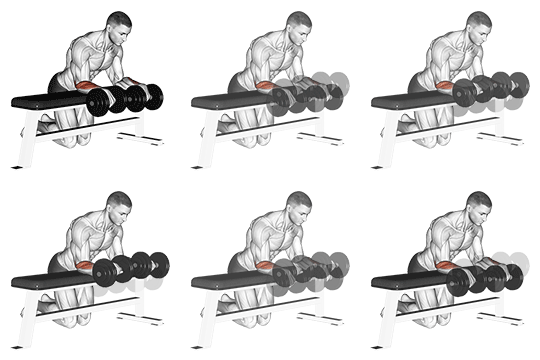
Dumbbell Over Bench Wrist Curl
Kneel at the bench with both forearms supported, palms up and the hands beyond the pad. Bend the wrists to bring the weights toward the forearms, then lower smoothly. Keep the handles secure and the elbows placed.
Go to the movement stepsAlso known as: Db Over Bench Wrist Curl, Dumbell Over Bench Wrist Curl
- Category
- Lower Arms
- Equipment
- Two Dumbbells And A Stable Flat Bench
- Movement focus
- Bilateral palm-up wrist flexion over a bench
Exercise reference published by PlanWorkouts; see our editorial standards.
How to Do the Dumbbell Over Bench Wrist Curl
- Kneel comfortably in front of a stable flat bench and hold both dumbbells with palms up.
- Support both forearms on the bench pad.
- Let your wrists hang over the edge of the bench.
- Bend both wrists upward within a comfortable range without lifting the forearms or bouncing the weights.
- Hold briefly, then lower your wrists back down under control.
Practice and progression
Keep a secure grip and use a comfortable wrist range with the forearm supported. Start with a load you can control without bouncing or lifting the elbow. Stop if pain develops; a loaded exercise reference is not an individual rehabilitation plan.
Technique references: Muscle & Strength: original wrist curl over bench. Original over-bench wrist-curl instructions supply kneeling, palm-up grip, forearm support and controlled wrist bending. The local loop confirms two hands. No maximal drop, compulsory squeeze or universal growth/frequency claim is adopted.
Technique & Form Tips
The wrists flex with palms upward while the bench supports both forearms. A supported setup does not make all body movement impossible or guarantee constant tension.
Common Mistakes to Avoid
- Moving the elbow instead of the wrist: Keep the forearm on its support and let the hand move relative to it. Do not curl toward the shoulder, bounce the weight or force a wrist angle to finish a repetition.
How to Breathe During This Exercise
Breathe steadily, exhaling as you raise the weight and inhaling as you lower it.
Comfort and Control
Stop if the movement causes pain. If you have an existing condition, ask a qualified professional about an appropriate exercise and range.
General guidance: Mayo Clinic on weight-training technique. Follow the specific movement steps above for this variation.
Community questions about this movement
For questions and discussions, visit the workout community. Community posts are separate from this exercise guide.