Chest Exercise · One Dumbbell And An Exercise Ball
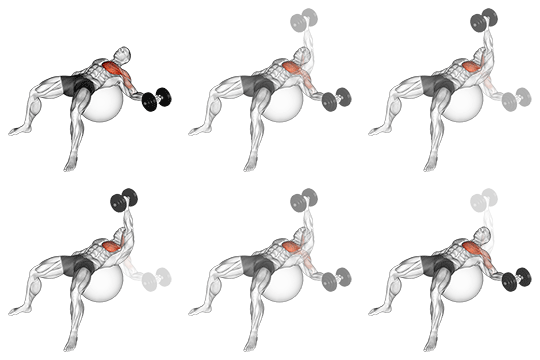
Dumbbell One Arm Chest Fly On Exercise Ball
One dumbbell moves outward and back in a fly arc while the upper back rests on the ball and both feet remain on the floor. The elbow stays slightly bent. Matching instruction for the one-sided loaded entry, support and exit is still needed before treating this as a complete procedure.
View setup and limitsAlso known as: Db One Arm Chest Fly On Exercise Ball, Dumbell One Arm Chest Fly On Exercise Ball
- Category
- Chest
- Equipment
- One Dumbbell And An Exercise Ball
- Movement focus
- One-weight ball fly; loaded handling unresolved
Exercise reference published by PlanWorkouts; see our editorial standards.
Demonstration Setup and Limits
- Observed support: the body is reclined against the ball with both feet on the floor and one dumbbell in the working hand. The free arm is unloaded.
- Observed action: the weight opens outward and returns above the chest with a small elbow bend, rather than repeatedly bending and straightening as a press.
- Obtain matching instruction for neck/back support, counterbalance and receiving/removing the weight before practice. Do not assume the paired fly or one-arm press provides the full loaded one-arm fly protocol.
Equipment and load handling
Ball size, inflation and weighted-use limits depend on the actual product. The demonstration does not approve a particular ball. Arrange help before loading if you cannot maintain support while receiving or removing the weights. Use a comfortable range without bouncing, forced joint locks or chasing a deeper stretch. Stop if pain develops.
Technique references: Muscle & Strength: exercise-ball dumbbell fly; dotFIT Me: ball dumbbell chest press and one-arm progression, printed page 131. Muscle & Strength describes a paired ball fly; dotFIT describes a one-arm press. They are comparisons, not complete one-arm-fly instructions for support, counterbalance and loaded entry or exit.
Technique & Form Tips
The working arm opens and closes while the other remains unloaded. The free-hand position alone does not establish a different muscle effect or a complete method for managing the offset weight.
Common Mistakes to Avoid
- Turning fly into a press: Keep the demonstrated elbow bend instead of repeatedly bending and straightening the elbows to press the load.
- Overstretching: Limit the backward movement of your arms to a range that feels stable and comfortable.
- Rushing the contraction: Use a controlled tempo through the entire range, especially as your hands move toward the center.
How to Breathe During This Exercise
Coordinate your breath with the opening and closing phases of the movement.
Comfort and Control
Stop if the movement causes pain. If you have an existing condition, ask a qualified professional about an appropriate exercise and range.
General guidance: Mayo Clinic on weight-training technique. Follow the specific movement steps above for this variation.
Community questions about this movement
For questions and discussions, visit the workout community. Community posts are separate from this exercise guide.