Chest Exercise · Cable

Cable Lying Fly
Lying flat for a cable fly changes the resistance angle compared to a standing or bench-inclined version, pulling the cables more directly across the chest at a fixed height. It's less common than a bench fly because the range of motion is more limited lying on the floor, but that limitation also makes it harder to cheat with shoulder involvement. It's a reasonable option when no bench is available near the cable stack.
Go to the movement stepsExercise reference published by PlanWorkouts; see our editorial standards.
How to Do the Cable Lying Fly
- Clip the handles onto the cables and lie back flat on a bench with your feet planted on the floor.
- Grip the handles palms-facing-in and press your arms straight up above your chest.
- With a slight bend held in your elbows, sweep your arms out to the sides in a wide arc until your chest feels stretched.
- Hold briefly at the bottom, then contract your chest to bring your arms back together overhead.
- Execute the desired number of reps with smooth cadence and consistent focus on the pectorals.
Quick Exercise Facts
Recommended Sets & Reps by Goal
Moderate weight · 60s rest
Lighter weight · 30–45s rest
Lower slowly for 3 seconds · 60s rest
Technique & Form Tips
Move your arms in a controlled arc toward the front of your body, focusing on horizontal adduction. Follow the demonstrated elbow angle and body support, ensuring your range of motion remains within your personal comfortable limits.
Common Mistakes to Avoid
- Turning fly into a press: Keep the demonstrated elbow bend instead of repeatedly bending and straightening the elbows to press the load.
- Overstretching: Limit the backward movement of your arms to a range that feels stable and comfortable.
- Rushing the contraction: Use a controlled tempo through the entire range, especially as your hands move toward the center.
How to Breathe During This Exercise
Coordinate your breath with the opening and closing phases of the movement.
Add the Cable Lying Fly to Your Custom Workout Routine
Build a personalized, science-backed workout plan matching your training goals, equipment access, and schedule.
Comfort and Control
Choose a load and range you can control. Stop if the movement causes pain. If discomfort persists, stop and ask a qualified professional about an appropriate exercise and range.
General guidance: Mayo Clinic on weight-training technique. Follow the specific movement steps above for this variation.
Muscles Worked
The Cable Lying Fly mainly targets your Pectorals, with your Deltoids helping support the movement, along with your Triceps.
More Chest Exercises
 Archer Push Up
 Assisted Chest Dip (kneeling)
 Assisted Seated Pectoralis Major Stretch With Stability Ball
 Assisted Wide-Grip Chest Dip (kneeling)
 Band Bench Press
 Band One Arm Twisting Chest Press
More Pectorals Exercises
 Barbell Bench Press
 Barbell Decline Bench Press
 Barbell Decline Pullover
 Barbell Decline Wide-Grip Press
 Barbell Front Raise And Pullover
 Barbell Guillotine Bench Press
Equipment Alternatives
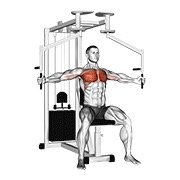
Don't have cable? These target the same pectorals with different equipment.


FAQ
- What muscles does the Cable Lying Fly work?
- The Cable Lying Fly mainly works your pectorals. It also helps strengthen your deltoids and triceps. Using good, smooth form makes sure you work the right muscles and avoid unnecessary strain on your joints.
- What equipment do I need for the Cable Lying Fly?
- You do the Cable Lying Fly with a cable. Make sure your equipment is set up safely before starting. If you work out at home or have limited gear, check out our alternative exercises below.
- What form mistake should I watch for on the Cable Lying Fly?
- One mistake to watch for is turning fly into a press: Keep the demonstrated elbow bend instead of repeatedly bending and straightening the elbows to press the load.. Use a comfortable range and a controlled return; reduce the load if you cannot maintain the demonstrated setup.
- How many sets and reps should I perform on the Cable Lying Fly?
- To tone and grow muscle, do 3 to 4 sets of 10 to 15 smooth reps with 60 seconds of rest, focusing on a full stretch and squeezing the muscle at the top of each rep.
- What's a good alternative to the Cable Lying Fly?
- The Dumbbell Decline Fly trains your pectorals with dumbbell and a similar movement pattern. Review its form guide before substituting it, since setup and range of motion can differ.