Waist Exercise · Body Weight
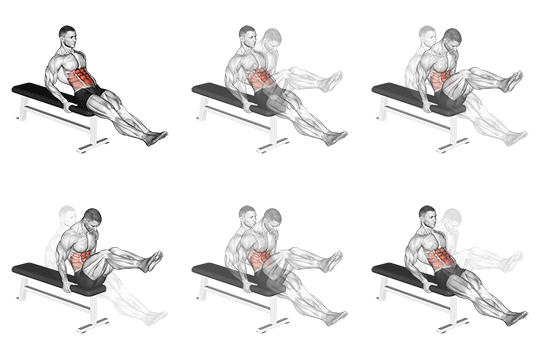
Seated Leg Raise
Seated leg raises shift the emphasis toward the hip flexors more than a floor-based leg raise does, since you're working against gravity from a different angle while the torso stays upright. It's a useful option for anyone whose lower back complains during floor ab work, because the seated position takes some of the lumbar strain out of the movement. Keep the core braced so the lift comes from the hips, not momentum.
Go to the movement steps- Category
- Waist
- Equipment
- Body Weight
- Target
- Abs
Exercise reference published by PlanWorkouts; see our editorial standards.
How to Do the Seated Leg Raise
- Sit on a flat bench with your spine upright and feet flat on the floor.
- Grip the sides of the bench with your hands for stability.
- With your legs kept straight, slowly lift them in front of you until they're level with the ground.
- Hold briefly at the top, then gradually bring your legs back down to start.
- Repeat for your desired repetitions, keeping constant tension on the working muscle throughout.
Quick Exercise Facts
Practice and progression
Choose a short set of controlled repetitions or a manageable hold, following this movement's setup. End the set when you lose the demonstrated position. Build control before increasing repetitions, duration or resistance; holds, carries and moving drills need different prescriptions.
Technique & Form Tips
Focus on trunk flexion, rotation, or anti-movement stability as required by your specific variation. Maintain the suggested pelvic and spinal orientation to keep tension focused on the abdominal area throughout each repetition or hold.
Common Mistakes to Avoid
- Copying the wrong trunk action: Follow the demonstrated movement. A held plank, rotation and crunch require different actions rather than the same repeated trunk curl.
- Lower back arching: Keep the spine controlled to prevent the lower back from hyperextending under the load.
- Excessive speed: Perform movements with deliberate control rather than relying on rapid, bouncing motions.
How to Breathe During This Exercise
Maintain a steady breathing rhythm during the effort.
Add the Seated Leg Raise to Your Custom Workout Routine
Build a personalized, science-backed workout plan matching your training goals, equipment access, and schedule.
Comfort and Control
Choose a load and range you can control. Stop if the movement causes pain. If discomfort persists, stop and ask a qualified professional about an appropriate exercise and range.
General guidance: Mayo Clinic on weight-training technique. Follow the specific movement steps above for this variation.
Muscles Worked
The Seated Leg Raise mainly targets your Abs, with your Hip Flexors helping support the movement.
More Waist Exercises
 3/4 Sit-Up
 45° Side Bend
 Air Bike
 Alternate Heel Touchers
 Arm Slingers Hanging Bent Knee Legs
 Arm Slingers Hanging Straight Legs
More Abs Exercises
 Arms Overhead Full Sit-Up (male)
 Assisted Hanging Knee Raise
 Assisted Hanging Knee Raise With Throw Down
 Assisted Lying Leg Raise With Lateral Throw Down
 Assisted Lying Leg Raise With Throw Down
 Assisted Motion Russian Twist
Equipment Alternatives
Don't have body weight? These target the same abs with different equipment.
Assisted Hanging Knee Raise
Assisted Motion Russian Twist
 Band Alternating V-Up
 Barbell Press Sit-Up
FAQ
- What muscles does the Seated Leg Raise work?
- The Seated Leg Raise mainly works your abs. Your hip flexors also works to help support and steady your body. Using good, smooth form makes sure you work the right muscles and avoid unnecessary strain on your joints.
- What equipment do I need for the Seated Leg Raise?
- You do the Seated Leg Raise with no equipment — just body weight. Make sure your equipment is set up safely before starting. If you work out at home or have limited gear, check out our alternative exercises below.
- What form mistake should I watch for on the Seated Leg Raise?
- One mistake to watch for is copying the wrong trunk action: Follow the demonstrated movement. A held plank, rotation and crunch require different actions rather than the same repeated trunk curl.. Use a comfortable range and a controlled return; reduce the load if you cannot maintain the demonstrated setup.
- How many sets and reps should I perform on the Seated Leg Raise?
- Use a short set of controlled repetitions, or a manageable hold when the movement is static. Stop when you cannot maintain the demonstrated position. Build control before adding duration, repetitions or resistance; the appropriate amount depends on the exercise and your experience.
- What's a good alternative to the Seated Leg Raise?
- The Assisted Hanging Knee Raise trains your abs with assisted and a similar movement pattern. Review its form guide before substituting it, since setup and range of motion can differ.