Waist Exercise · Body Weight

Frog Crunch
- Category
- Waist
- Equipment
- Body Weight
- Target
- Abs
Biomechanical cues verified by the PlanWorkouts Science Review Board under CSCS editorial oversight; see our editorial standards.
The Frog Crunch is a targeted isolation waist movement designed to train the Abs.
Trunk flexion, anti-extension, or anti-rotation targeting rectus abdominis and obliques. Requires posterior pelvic tilt to isolate abdominal fibers. Executing this with strict form maximizes muscle fiber recruitment while protecting joint structures.
Quick Exercise Facts
Target Muscle Activation
Bringing the knees out wide like a frog while crunching shifts some emphasis onto the hip flexors and inner thighs alongside the abs, compared to a standard crunch with the knees together. It's a variation worth rotating in for the different hip angle rather than a wholesale replacement for straight crunches.
How to Do the Frog Crunch
- Lie on your back with your knees bent and your feet flat on the floor.
- Rest your hands behind your head with elbows pointed outward.
- Contract your abs to curl your upper body up off the floor until your torso reaches about a 45-degree angle.
- Pause momentarily at the top, then lower your upper body back down slowly.
- Complete your planned set count, emphasizing full range of motion and strong peak contraction in the abs.
Recommended Sets & Reps by Training Goal
65–75% 1RM · 60s rest
50–60% 1RM · 30–45s rest
Controlled 3s eccentric · 60s rest
Biomechanical & Joint Load Cues
Trunk flexion, anti-extension, or anti-rotation targeting rectus abdominis and obliques. Requires posterior pelvic tilt to isolate abdominal fibers.
Common Mechanical Mistakes & Form Errors to Avoid
- Pulling on the Neck / Cervical Spine: Yanking the head forward with hands during crunches places excessive strain on cervical vertebrae without engaging the abs.
- Arching Lower Back Under Load: Allowing the lumbar spine to hyperextend during leg raises shifts work to the psoas hip flexors and pinches facet joints.
- Rushing Through Reps: Using fast bouncing tempo bypasses deep transverse abdominis engagement; slow reps with a full exhale build real core strength.
Proper Breathing Patterns & Core Engagement
Exhale completely during spinal flexion or maximal tension to maximize abdominal contraction; inhale on controlled return.
Add the Frog Crunch to Your Custom Workout Routine
Build a personalized, science-backed workout plan matching your training goals, equipment access, and schedule.
Injury Modification & Joint Safety
Individuals with lumbar disc herniations should prioritize isometric anti-extension (planks, dead bugs) over repetitive loaded spinal flexion. If joint irritation persists, immediately stop and substitute this movement with another exercise from the Waist exercises category.
Muscles Worked
The Frog Crunch primarily targets the Abs, with Hip Flexors as the primary synergist muscle group.
More Waist Exercises
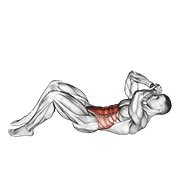 3/4 Sit-Up
 45° Side Bend
 Air Bike
 Alternate Heel Touchers
 Arm Slingers Hanging Bent Knee Legs
 Arm Slingers Hanging Straight Legs
More Abs Exercises
 Arms Overhead Full Sit-Up (male)
 Assisted Hanging Knee Raise
 Assisted Hanging Knee Raise With Throw Down
 Assisted Lying Leg Raise With Lateral Throw Down
 Assisted Lying Leg Raise With Throw Down
 Assisted Motion Russian Twist
Equipment Alternatives
Don't have body weight? These target the same abs with different equipment.
Assisted Hanging Knee Raise
Assisted Motion Russian Twist
 Band Alternating V-Up
 Barbell Press Sit-Up
FAQ
- What muscles does the Frog Crunch work?
- The Frog Crunch primarily targets the abs as the primary agonist. The hip flexors acts as the primary supporting muscle group during force transmission. Maintaining strict biomechanical alignment ensures maximal tension remains focused on the intended muscle fibers rather than shifting to surrounding stabilizer joints.
- What equipment do I need for the Frog Crunch?
- The Frog Crunch is performed using no equipment — just body weight. Ensure all equipment is securely positioned with collars or safety pins locked before loading working sets. If you train in a home gym or minimal setup, explore our equipment-free and resistance band alternatives below.
- What is the most common form mistake on the Frog Crunch?
- The most frequent error is pulling on the neck / cervical spine: Yanking the head forward with hands during crunches places excessive strain on cervical vertebrae without engaging the abs.. Controlling the 2 to 3-second eccentric lowering phase ensures maximal hypertrophic stimulus while shielding connective tissue.
- How many sets and reps should I perform on the Frog Crunch?
- For muscle growth and density, execute 3 to 4 working sets of 10 to 15 controlled repetitions with 60 seconds rest, emphasizing a deep stretch and deliberate peak contraction on every rep.
- What's a good alternative to the Frog Crunch?
- If you don't have access to the space or setup it needs, the Assisted Hanging Knee Raise targets the same abs using assisted instead. This alternative replicates the same joint angle and movement plane while allowing you to train effectively with different available gear. You can also substitute it seamlessly in our free Workout Plan Builder.