Waist Exercise · Cable Handle, Both Hands And Suitable Stability Ball
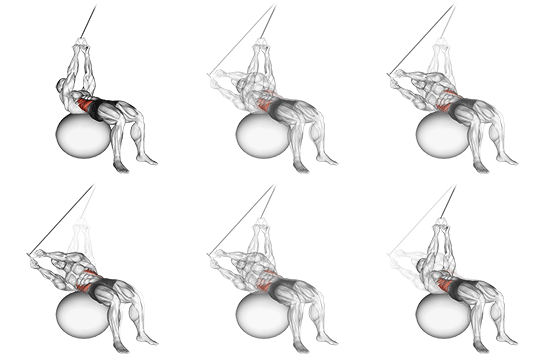
Cable Russian Twists (on Stability Ball)
Lie back on the ball with the feet planted and both hands extended over the chest. Turn the upper torso away from the cable and return under control; this is not an upright seated hip-to-hip twist.
Go to the movement steps- Category
- Waist
- Equipment
- Cable Handle, Both Hands And Suitable Stability Ball
- Movement focus
- Lying ball-supported cable rotation away from the machine
Exercise reference published by PlanWorkouts; see our editorial standards.
How to Do the Cable Russian Twists (on Stability Ball)
- Use a suitable ball beside the cable station and confirm controlled handle access. Arrange the pulley around the extended-hand line or higher, as in the linked matching setup.
- Lie back with the upper back supported, knees bent and feet secure. Hold the handle with both hands extended above the chest.
- Keep the arm position steady as the upper torso turns away from the cable through a comfortable range, maintaining stable foot and ball support.
- Return slowly without letting the cable pull you into a fast turn. Complete one side, then reset the ball and cable orientation for the other side.
Ball and handle access
Use a ball suitable for the exercise and loading, on a clear nonslip floor. The loop omits entry and exit; have qualified staff check the setup if you cannot take and return the handles with control.
Technique references: Fitness Volt: ball-supported cable Russian twist instructions; JEFIT: low-pulley ball-supported twist comparison. The local demonstration identifies this variation. Linked original written coaching supports the specified physical components; it does not establish greater activation, growth, rehabilitation suitability or sporting transfer.
Technique & Form Tips
The torso rotates while the hands stay extended relative to the chest. The loop shows a turn and return on one side, rather than alternating the handle between the hips.
Common Mistakes to Avoid
- Using a seated hip-to-hip pattern: Keep the demonstrated lying support and controlled turn. Do not force a larger rotation or let the cable drag the body across the ball.
How to Breathe During This Exercise
Maintain a steady breathing rhythm during the effort.
Comfort and Control
Stop if the movement causes pain. If you have an existing condition, ask a qualified professional about an appropriate exercise and range.
General guidance: Mayo Clinic on weight-training technique. Follow the specific movement steps above for this variation.
Community questions about this movement
For questions and discussions, visit the workout community. Community posts are separate from this exercise guide.