Upper Legs Exercise · Cable
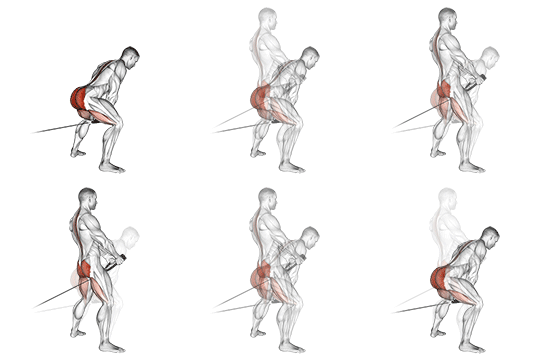
Cable Pull Through (with Rope)
- Category
- Upper Legs
- Equipment
- Cable
- Target
- Glutes
Biomechanical cues verified by the PlanWorkouts Science Review Board under CSCS editorial oversight; see our editorial standards.
The Cable Pull Through (with Rope) is a targeted isolation upper legs movement designed to train the Glutes with direct engagement of the Lower Back.
Controlled plane of motion engaging target synergist muscle groups. Focus on deliberate eccentric control (2-3s) and active range of motion. Executing this with strict form maximizes muscle fiber recruitment while protecting joint structures.
Quick Exercise Facts
Target Muscle Activation
The cable pull through trains the hip hinge pattern using a low pulley instead of a barbell, which makes it a common teaching tool for lifters still learning to load the glutes and hamstrings without rounding the lower back. Because the cable pulls from behind rather than from the floor, there's less technical demand than a deadlift while still building the same hinge pattern. It's often used as a warm-up or accessory rather than a primary lift.
How to Do the Cable Pull Through (with Rope)
- Turn your back to the cable machine and stand with your feet shoulder-width apart.
- Take the rope attachment in both hands and step forward until the cable pulls taut.
- Hinge at your hips to lower your torso toward parallel with the floor, keeping your spine straight.
- Drive your glutes and hamstrings to pull yourself back up to standing.
- Execute the desired number of reps with smooth cadence and consistent focus on the glutes.
Recommended Sets & Reps by Training Goal
65–75% 1RM · 60s rest
50–60% 1RM · 30–45s rest
Controlled 3s eccentric · 60s rest
Biomechanical & Joint Load Cues
Controlled plane of motion engaging target synergist muscle groups. Focus on deliberate eccentric control (2-3s) and active range of motion.
Common Mechanical Mistakes & Form Errors to Avoid
- Uncontrolled Lifting Tempo: Rushing through reps without establishing mind-muscle connection or eccentric control reduces muscle fiber tension.
- Spine Hyperextension: Compensating for limited joint range of motion by arching the lower back risks spinal facet strain.
- Unstable Foot Base: Poor foot position causing balance loss during movement execution creates energy leaks and injury risk.
Proper Breathing Patterns & Core Engagement
Inhale during eccentric lowering phase; exhale during concentric work phase.
Add the Cable Pull Through (with Rope) to Your Custom Workout Routine
Build a personalized, science-backed workout plan matching your training goals, equipment access, and schedule.
Injury Modification & Joint Safety
Stop immediately if movement causes sharp joint or tendon pain; substitute with a joint-friendly variant. If joint irritation persists, immediately stop and substitute this movement with another exercise from the Upper Legs exercises category.
Muscles Worked
The Cable Pull Through (with Rope) primarily targets the Glutes, with Hamstrings as the primary synergist muscle group, along with the Lower Back.
More Upper Legs Exercises
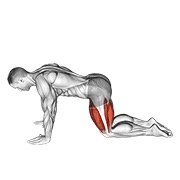 All Fours Squad Stretch
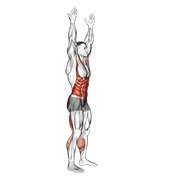 Arms Apart Circular Toe Touch (male)
 Assisted Lying Glutes Stretch
 Assisted Lying Gluteus And Piriformis Stretch
 Assisted Prone Hamstring
 Assisted Prone Lying Quads Stretch
More Glutes Exercises
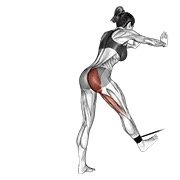 Band Bent-Over Hip Extension
 Band Hip Lift
 Band Lying Hip Internal Rotation
 Band Pull Through
 Band Seated Hip Internal Rotation
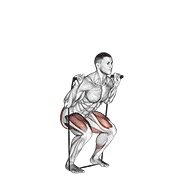 Band Squat
Equipment Alternatives
Don't have cable? These target the same glutes with different equipment.
 Basic Toe Touch (male)
Band Bent-Over Hip Extension
Basic Toe Touch (male)
Band Bent-Over Hip Extension
 Barbell Clean-Grip Front Squat
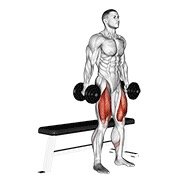 Dumbbell Bench Squat
FAQ
- What muscles does the Cable Pull Through (with Rope) work?
- The Cable Pull Through (with Rope) primarily targets the glutes as the primary agonist. Synergist assistance is provided by the hamstrings along with the lower back. Maintaining strict biomechanical alignment ensures maximal tension remains focused on the intended muscle fibers rather than shifting to surrounding stabilizer joints.
- What equipment do I need for the Cable Pull Through (with Rope)?
- The Cable Pull Through (with Rope) is performed using a cable. Ensure all equipment is securely positioned with collars or safety pins locked before loading working sets. If you train in a home gym or minimal setup, explore our equipment-free and resistance band alternatives below.
- What is the most common form mistake on the Cable Pull Through (with Rope)?
- The most frequent error is uncontrolled lifting tempo: Rushing through reps without establishing mind-muscle connection or eccentric control reduces muscle fiber tension.. Controlling the 2 to 3-second eccentric lowering phase ensures maximal hypertrophic stimulus while shielding connective tissue.
- How many sets and reps should I perform on the Cable Pull Through (with Rope)?
- For muscle growth and density, execute 3 to 4 working sets of 10 to 15 controlled repetitions with 60 seconds rest, emphasizing a deep stretch and deliberate peak contraction on every rep.
- What's a good alternative to the Cable Pull Through (with Rope)?
- If you don't have access to a cable, the Basic Toe Touch (male) targets the same glutes using body weight instead. This alternative replicates the same joint angle and movement plane while allowing you to train effectively with different available gear. You can also substitute it seamlessly in our free Workout Plan Builder.