Upper Legs Exercise · Assisted
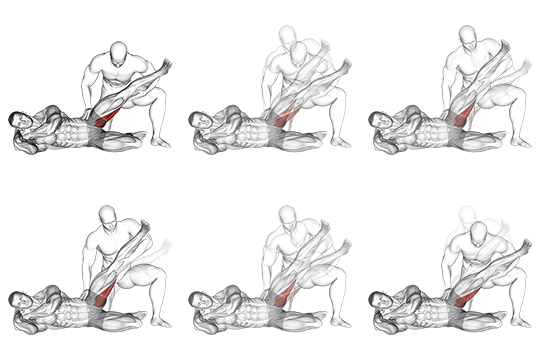
Assisted Side Lying Adductor Stretch
The Assisted Side Lying Adductor Stretch is a flexibility movement for the adductors. Follow the demonstrated setup and the movement steps within a comfortable range.
Go to the movement steps- Category
- Upper Legs
- Equipment
- Assisted
- Target
- Adductors
Exercise reference published by PlanWorkouts; see our editorial standards.
How to Do the Assisted Side Lying Adductor Stretch
- Lie on one side with your legs straight and one resting on top of the other.
- Add a slight bend to the leg underneath for a stable base.
- Rest the foot of your top leg on something stable, like a step or bench.
- Keep that top leg straight and let it drop gradually toward the floor until you feel the stretch along your inner thigh.
- Stay in that stretched position for roughly 20 to 30 seconds.
- Come back to where you started, then switch sides and repeat.
Quick Exercise Facts
Stretch Duration & Control
Follow the hold duration or controlled repetitions in the movement steps. A held stretch and a moving stretch use different approaches; bodybuilding sets-and-reps targets do not apply.
Move smoothly, keep breathing comfortably and avoid forcing an uncomfortable range.
For general guidance, see the NHS flexibility exercises.
Technique & Form Tips
Use the setup and movement shown in the demonstration. Move slowly within a comfortable range; a stretch should not be treated as a loaded lifting exercise.
Common Mistakes to Avoid
- Forcing the range: Ease back if the position is uncomfortable rather than pulling harder.
- Bouncing or jerking: Move smoothly and keep held positions steady.
- Using lifting targets: Follow the hold duration or controlled repetitions in the movement steps instead of using a bodybuilding sets-and-reps target.
How to Breathe During This Exercise
Keep breathing comfortably throughout the movement or hold rather than holding your breath.
Add the Assisted Side Lying Adductor Stretch to Your Custom Workout Routine
Build a personalized, science-backed workout plan matching your training goals, equipment access, and schedule.
Comfort and Control
Do not force the range or stretch into pain. Ask a qualified professional about suitable movements if you have an injury or an existing condition. If discomfort persists, stop and ask a qualified professional about an appropriate exercise and range.
General guidance: Mayo Clinic on weight-training technique. Follow the specific movement steps above for this variation.
Muscles Worked
The Assisted Side Lying Adductor Stretch mainly targets your Adductors, with your Hamstrings helping support the movement, along with your Glutes.
More Upper Legs Exercises
 All Fours Squad Stretch
 Arms Apart Circular Toe Touch (male)
 Assisted Lying Glutes Stretch
 Assisted Lying Gluteus And Piriformis Stretch
 Assisted Prone Hamstring
 Assisted Prone Lying Quads Stretch
More Adductors Exercises
 Butterfly Yoga Pose
 Cable Hip Adduction
 Lever Seated Hip Adduction
 Side Lying Hip Adduction (male)
 Side Plank Hip Adduction
FAQ
- What muscles does the Assisted Side Lying Adductor Stretch stretch?
- The Assisted Side Lying Adductor Stretch is a stretch for the adductors. Use the setup shown in the demonstration and stay within a comfortable range.
- What equipment do I need for the Assisted Side Lying Adductor Stretch?
- You do the Assisted Side Lying Adductor Stretch with a partner or assistance device appropriate to the movement. Make sure your equipment is set up safely before starting. If you work out at home or have limited gear, check out our alternative exercises below.
- What form mistake should I watch for on the Assisted Side Lying Adductor Stretch?
- Avoid forcing the range, bouncing or holding your breath. Follow the specific movement steps and ease out of an uncomfortable position.
- How long should I perform the Assisted Side Lying Adductor Stretch?
- Follow the hold duration or controlled repetitions in the movement steps. Static holds and moving stretches use different approaches; do not substitute a muscle-building sets-and-reps target. Use a range you can control comfortably.