Upper Legs Exercise · Body Weight And Clear Nonslip Floor Space
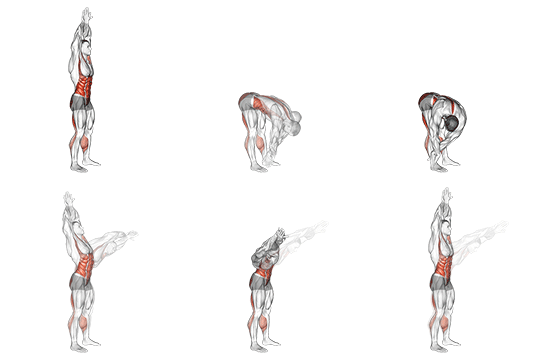
Hands Reversed Clasped Circular Toe Touch (male)
The hands are together overhead before the forward circular reach. The loop does not show a behind-the-legs clasp, and the exact reversed finger and palm arrangement needs a clearer demonstration.
View setup and limits- Category
- Upper Legs
- Equipment
- Body Weight And Clear Nonslip Floor Space
- Movement focus
- Overhead reversed-clasp circular toe-touch reference; grip routing unresolved
Exercise reference published by PlanWorkouts; see our editorial standards.
Demonstration Setup and Limits
- Visible start: standing with both arms overhead and the hands together.
- Visible motion: the upper body folds forward and travels through a circular arc before returning upright.
- The close hand view does not establish a complete finger-routing or shoulder-position protocol.
Grip and range
Do not force a finger interlock, pull the arms behind the legs or chase toe contact from this limited reference. Obtain a clear matched grip demonstration before using the specific clasp.
Technique references: JEFIT: standing toe-touch stretch; static hold differs; Mayo Clinic: smooth, comfortable stretching. The local animation establishes visible support and motion. Written sources support the stated components; differences are described explicitly. No original testing or comparative muscle, medical or ranking result is claimed.
Technique & Form Tips
The two local variants have broadly similar body arcs, with a visible hand-orientation difference that does not establish exact clasp routing or a required rotation direction.
Common Mistakes to Avoid
- Changing the support or forcing the motion: Move only through a comfortable range without momentum or forced contact.
How to Breathe During This Exercise
Breathe steadily throughout the movement.
Comfort and Control
Stop if the movement causes pain. If you have an existing condition, ask a qualified professional about an appropriate exercise and range.
General guidance: Mayo Clinic on weight-training technique. Follow the specific movement steps above for this variation.
Community questions about this movement
For questions and discussions, visit the workout community. Community posts are separate from this exercise guide.