Waist Exercise · Body Weight
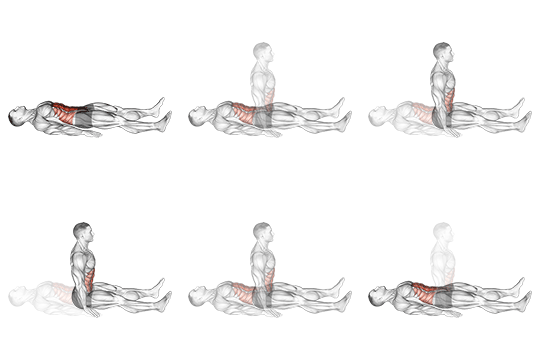
Half Sit-Up (male)
Although the source labels this movement half sit-up, the animation keeps the legs extended on the floor as the torso rises and lowers. The arms remain alongside the body. Bent knees, hands behind the head and a fixed 45-degree endpoint do not describe the visible sequence.
Go to the movement steps- Category
- Waist
- Equipment
- Body Weight
- Target
- Abs
Exercise reference published by PlanWorkouts; see our editorial standards.
How to Do the Half Sit-Up (male)
- Lie on your back with the legs extended and the arms alongside your body.
- Begin raising the torso smoothly while keeping the legs supported on the floor.
- Rise only through a range you can control comfortably; do not force a particular angle or pull on the head.
- Lower the torso slowly with the arms still alongside the body.
- Reset between repetitions and stop if the straight-leg position causes discomfort or uncontrolled pulling.
Source name and visible movement
This page retains the historical half sit-up URL. Its instructions describe the straight-leg demonstration rather than an assumed bent-knee variation.
Technique & Form Tips
The trunk rises over supported straight legs. A bent-knee crunch and a straight-leg sit-up have different setups; the source label alone does not specify the range.
Common Mistakes to Avoid
- Pulling behind the head: Keep the arms alongside the body as shown instead of pulling on the neck.
- Forcing the range: The illustration does not prescribe a required angle or prove that the full shown range suits every person.
How to Breathe During This Exercise
Breathe out while rising and in during the controlled return.
Comfort and Control
Stop if the movement causes pain. If you have an existing condition, ask a qualified professional about an appropriate exercise and range.
General guidance: Mayo Clinic on weight-training technique. Follow the specific movement steps above for this variation.
Community questions about this movement
For questions and discussions, visit the workout community. Community posts are separate from this exercise guide.