Upper Arms Exercise · Two Dumbbells
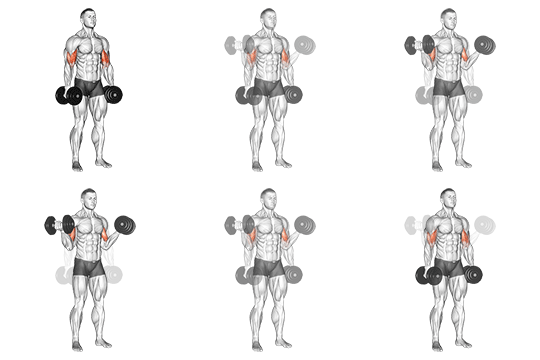
Dumbbell Standing Inner Biceps Curl V. 2
Curl both dumbbells together along a comfortable outward path, keeping the palms generally upward as the forearms rise. The exercise name does not establish selective inner-head growth or a requirement to rotate the palms inward at the top.
Go to the movement stepsAlso known as: Dumbbell Standing Inner Bicep Curl V. 2, Db Standing Inner Biceps Curl V. 2, Dumbell Standing Inner Biceps Curl V. 2
- Category
- Upper Arms
- Equipment
- Two Dumbbells
- Movement focus
- Bilateral standing dumbbell curl with a comfortable outward forearm path
Exercise reference published by PlanWorkouts; see our editorial standards.
How to Do the Dumbbell Standing Inner Biceps Curl V. 2
- Stand with feet comfortably apart and hold a dumbbell in each hand beside the thighs. Keep the torso upright and the wrists aligned.
- Set the hands in a comfortable underhand orientation and let the forearms travel slightly outward as both elbows bend. Keep the upper arms near the sides without forcing them tightly against the ribs.
- Raise both dumbbells through a comfortable range. Avoid twisting the palms inward or lifting the shoulders to chase a compulsory peak contraction.
- Breathe in as you slowly return the dumbbells to the starting position.
Practice and progression
Choose a load and comfortable range that preserve the stated grip and support. Lower smoothly, stop before a forced joint endpoint, and reduce the load if the torso swings or support shifts. Stop if pain develops.
Technique references: MUSQLE: original palms-up grip and controlled bilateral curl; Mayo Clinic: original biceps-curl transcript. MUSQLE supplies a turn toward palms-up and slow, controlled bilateral curls; the comfortable outward forearm path is shown by this illustration. Mayo supplies the ordinary controlled curl component. Wrist-strain relief, cheating recommendations, selective growth and finisher/load-hierarchy claims are not adopted.
Technique & Form Tips
The forearms rise outward together rather than crossing the weights in front of the chest. Use a comfortable shoulder position; neither the label nor the illustration establishes a special muscle-head effect.
Common Mistakes to Avoid
- Treating a support or grip as a guarantee: Keep the actual contact and hand orientation clear. Avoid forced elbow locking, a compulsory shoulder-height squeeze or using the torso to finish the repetition.
How to Breathe During This Exercise
Breathe steadily throughout the movement, ideally exhaling during the contraction phase.
Comfort and Control
Stop if the movement causes pain. If you have an existing condition, ask a qualified professional about an appropriate exercise and range.
General guidance: Mayo Clinic on weight-training technique. Follow the specific movement steps above for this variation.
Community questions about this movement
For questions and discussions, visit the workout community. Community posts are separate from this exercise guide.