Upper Arms Exercise · Two Dumbbells And A Correctly Fitted Arm Blaster
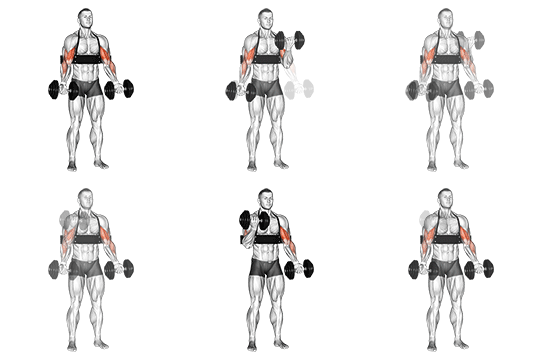
Dumbbell Alternate Biceps Curl (with Arm Blaster)
Fit the arm blaster before taking the dumbbells, then curl and lower one arm before repeating with the other. The backs of the upper arms contact the curved support. The device is a contact aid, not a guarantee that the torso or shoulders cannot move.
Go to the movement stepsAlso known as: Dumbbell Alternate Bicep Curl (With Arm Blaster), Db Alternate Biceps Curl (With Arm Blaster), Dumbell Alternate Biceps Curl (With Arm Blaster)
- Category
- Upper Arms
- Equipment
- Two Dumbbells And A Correctly Fitted Arm Blaster
- Movement focus
- Sequential alternating curls with upper-arm blaster contact
Exercise reference published by PlanWorkouts; see our editorial standards.
How to Do the Dumbbell Alternate Biceps Curl (with Arm Blaster)
- Fit and adjust the blaster without weights, following its manufacturer’s instructions. Establish comfortable contact against the backs of the upper arms without forcing the elbows or letting the strap pull the head forward. Only then take the dumbbells.
- Stand tall with feet shoulder-width apart, holding a dumbbell in each hand with palms facing forward.
- Curl one forearm through a comfortable range while maintaining light contact against the support and an aligned wrist.
- Inhale and slowly lower the dumbbell back down to the start.
- Perform the same curl with the opposite arm.
- Keep alternating arms for the desired number of repetitions.
- Set the dumbbells down before adjusting or removing the blaster. Follow the release instructions for your own model; do not assume every strap uses the same buckle.
Practice and progression
Use a load and comfortable range that maintain the shown support and aligned wrists. Lower smoothly rather than dropping into the elbow’s end range. Stop before the torso swings, the support shifts or pain develops.
Technique references: Rogue: original arm-blaster product and neck-strap design; Rogue: original arm-blaster manual and removal caution; FitStep: original first-person arm-blaster use review; Mayo Clinic: original seated/standing biceps curl transcript. Rogue identifies the strapped curl-support device; its three-page manual gives a model-specific buckle-removal caution, not complete fitting coaching. FitStep supplies original first-person contact-against-plate and neck/return-control observations. Mayo supplies the ordinary curl component. The local full loop supplies sequential alternating timing. No material, growth or isolation guarantee is adopted.
Technique & Form Tips
One elbow bends and returns while the other arm remains low; then the sides switch. The 24-frame loop includes both low positions between curls, unlike a reciprocal raise-and-lower pattern.
Common Mistakes to Avoid
- Forcing a support, grip or endpoint: Do not swing the torso, force an elbow against a brace, bend the wrists or chase a compulsory shoulder-height squeeze. Keep the equipment and the return controlled.
How to Breathe During This Exercise
Breathe steadily throughout the movement, ideally exhaling during the contraction phase.
Comfort and Control
Stop if the movement causes pain. If you have an existing condition, ask a qualified professional about an appropriate exercise and range.
General guidance: Mayo Clinic on weight-training technique. Follow the specific movement steps above for this variation.
Community questions about this movement
For questions and discussions, visit the workout community. Community posts are separate from this exercise guide.