Upper Legs Exercise · Barbell And Suitable Rack/safety Setup
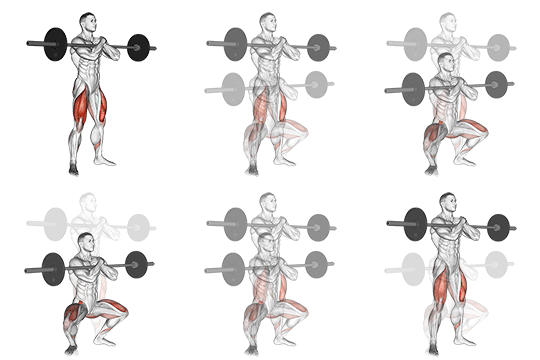
Barbell Zercher Squat
Cradle the bar in the crooks of the elbows and keep the forearms raised as you squat and stand. The hands may clasp together while the elbow creases support the bar. Choose stance and depth you can control without assuming that arm discomfort must be the limiting factor.
Go to the movement stepsAlso known as: Zercher Squat, Elbow Squat
- Category
- Upper Legs
- Equipment
- Barbell And Suitable Rack/safety Setup
- Movement focus
- Elbow-cradled squat; distinguish arm support from hand grip
Exercise reference published by PlanWorkouts; see our editorial standards.
How to Do the Barbell Zercher Squat
- Use a suitable rack and safety setup with a manageable bar and secured plates. Have qualified staff teach bar placement, unracking and return before adding load.
- Use a rack height that lets you settle both elbow creases under the bar without a floor pickup. Learn the take-out and return with qualified staff.
- Stand with your feet shoulder-width apart and your toes turned out slightly.
- Place the bar in the crooks of both elbows with the forearms raised; clasping the hands is optional, rather than gripping the bar itself with the hands.
- Brace your core and keep your chest lifted as you lower your hips back and down into a squat.
- Keep the knees following the feet and your balance over the whole foot, rather than settling the weight only in the heels.
- Descend only while the bar remains securely cradled and the trunk and feet stay controlled, then press through the floor to stand.
- Repeat for your planned rep target, maintaining clean technique and steady breathing on every repetition.
- Finish upright with control and return the bar to the rack using the handling you have learned; do not release it before it is supported.
Choose the matching variation
The full Zercher page shares the same general elbow support. Its name does not prove a required depth or separate muscle effect; a floor deadlift also needs a different setup.
Technique references: Shane McLean original Zercher squat instruction; Scott Bird original Zercher squat and deadlift setup distinction. The support and movement pattern agree with the cited technique. Personal stance, range, load and equipment handling require individual control; this reference does not measure joint forces, muscle activation or training outcomes.
Technique & Form Tips
The load is held in front by the bent arms while the hips and knees move. This does not require a perfectly vertical torso or establish a particular muscle equivalence to a front squat.
Common Mistakes to Avoid
- Trying to grip the bar as a front squat: Keep the bar supported in the elbow creases with the forearms raised, rather than resting it in the hands.
- Ignoring discomfort or sliding support: Reduce the load or stop if the hold is painful or unstable; padding is optional and cannot substitute for a controlled fit.
How to Breathe During This Exercise
Breathe in a steady, controlled rhythm throughout the effort.
Comfort and Control
Stop if the movement causes pain. If you have an existing condition, ask a qualified professional about an appropriate exercise and range.
General guidance: Mayo Clinic on weight-training technique. Follow the specific movement steps above for this variation.
Community questions about this movement
For questions and discussions, visit the workout community. Community posts are separate from this exercise guide.