Upper Legs Exercise · Barbell
Biomechanical cues verified by the PlanWorkouts Science Review Board under CSCS editorial oversight; see our editorial standards.
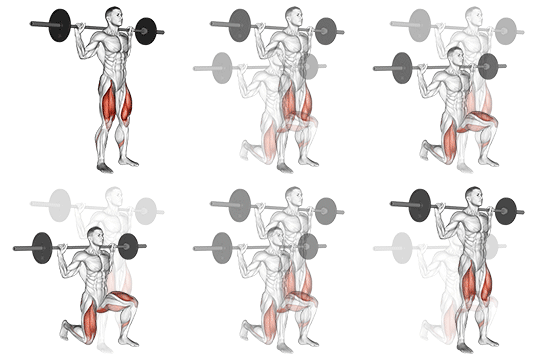
The Barbell Rear Lunge is a compound upper legs movement designed to train the Glutes with direct engagement of the Hamstrings, Calves.
Operates primarily in the sagittal plane involving knee flexion/extension and hip extension. Peak mechanical tension occurs in the deep lengthened position at the bottom transition. Maintain midfoot balance and an upright torso angle. Executing this with strict form maximizes muscle fiber recruitment while protecting joint structures.
Quick Exercise Facts
Target Muscle Activation
The barbell rear lunge, sometimes called a reverse lunge, steps backward instead of forward, which is generally easier on the knees since the front knee travels less far past the toes. It still trains the glutes and quads unilaterally like a forward lunge. Keep the torso upright and control the step back rather than letting the trailing leg slam down.
How to Do the Barbell Rear Lunge
- Begin standing with your feet shoulder-width apart, the barbell resting across your upper back.
- Step backward with your right foot, touching down on the ball of that foot.
- Bend both knees together to lower down until your left thigh is parallel with the floor.
- Drive through your left heel to bring yourself back up to the start.
- Switch and perform the same movement stepping back with the other leg.
Recommended Sets & Reps by Training Goal
70–80% 1RM · 90–120s rest
85%+ 1RM · 2–3 min rest (Calc 1RM)
50–60% 1RM · 45–60s rest
Biomechanical & Joint Load Cues
Operates primarily in the sagittal plane involving knee flexion/extension and hip extension. Peak mechanical tension occurs in the deep lengthened position at the bottom transition. Maintain midfoot balance and an upright torso angle.
Common Mechanical Mistakes & Form Errors to Avoid
- Knee Valgus (Inward Collapse): Allowing knees to cave inward during the ascent places excessive tensile stress on the MCL and lateral meniscus. Drive knees out in line with second toes.
- Excessive Forward Pitch: Allowing the chest to drop and hips to shoot up turns the squat into a good-morning, transferring load off the quadriceps onto the lumbar erectors.
- Heel Lift & Weight Shift: Shifting balance forward onto the balls of the feet compromises stability and increases patellar tendon strain. Keep weight distributed over midfoot.
Proper Breathing Patterns & Core Engagement
Perform a deep abdominal brace (Valsalva maneuver) into the diaphragm before initiating descent. Hold intra-abdominal pressure through the bottom transition, exhaling past the sticking point on ascent.
Add the Barbell Rear Lunge to Your Custom Workout Routine
Build a personalized, science-backed workout plan matching your training goals, equipment access, and schedule.
Injury Modification & Joint Safety
Lifters experiencing acute patellofemoral knee discomfort should moderate depth to parallel or utilize box squats to reduce peak anterior patellar shear. If joint irritation persists, immediately stop and substitute this movement with another exercise from the Upper Legs exercises category.
Muscles Worked
The Barbell Rear Lunge primarily targets the Glutes, with Quadriceps as the primary synergist muscle group, along with the Hamstrings, Calves.
More Upper Legs Exercises
 All Fours Squad Stretch
 Arms Apart Circular Toe Touch (male)
 Assisted Lying Glutes Stretch
 Assisted Lying Gluteus And Piriformis Stretch
 Assisted Prone Hamstring
 Assisted Prone Lying Quads Stretch
More Glutes Exercises
 Band Bent-Over Hip Extension
 Band Hip Lift
 Band Lying Hip Internal Rotation
 Band Pull Through
 Band Seated Hip Internal Rotation
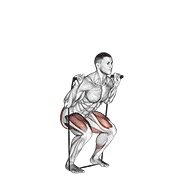 Band Squat
Equipment Alternatives
Don't have barbell? These target the same glutes with different equipment.

FAQ
- What muscles does the Barbell Rear Lunge work?
- The Barbell Rear Lunge primarily targets the glutes as the primary agonist. Synergist assistance is provided by the quadriceps along with the hamstrings, calves. Maintaining strict biomechanical alignment ensures maximal tension remains focused on the intended muscle fibers rather than shifting to surrounding stabilizer joints.
- What equipment do I need for the Barbell Rear Lunge?
- The Barbell Rear Lunge is performed using a barbell. Ensure all equipment is securely positioned with collars or safety pins locked before loading working sets. If you train in a home gym or minimal setup, explore our equipment-free and resistance band alternatives below.
- What is the most common form mistake on the Barbell Rear Lunge?
- The most frequent error is knee valgus (inward collapse): Allowing knees to cave inward during the ascent places excessive tensile stress on the MCL and lateral meniscus. Drive knees out in line with second toes.. Controlling the 2 to 3-second eccentric lowering phase ensures maximal hypertrophic stimulus while shielding connective tissue.
- How many sets and reps should I perform on the Barbell Rear Lunge?
- For muscle hypertrophy and size, aim for 3 to 4 working sets of 8 to 12 repetitions at 70% to 80% of your 1RM with 90 to 120 seconds rest. For absolute strength development, prioritize 4 to 5 sets of 3 to 6 heavier reps with 2 to 3 minutes rest.
- What's a good alternative to the Barbell Rear Lunge?
- If you don't have access to a barbell, the Basic Toe Touch (male) targets the same glutes using body weight instead. This alternative replicates the same joint angle and movement plane while allowing you to train effectively with different available gear. You can also substitute it seamlessly in our free Workout Plan Builder.