Upper Legs Exercise · Barbell
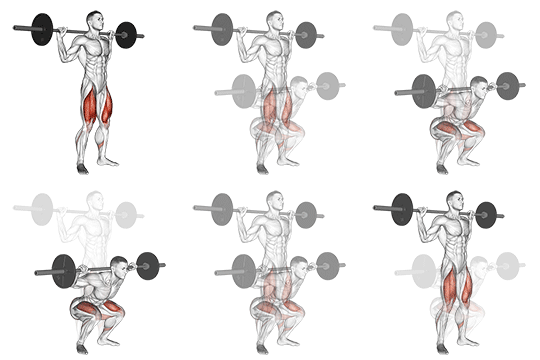
Barbell Full Squat
Few exercises tax the whole body like a full barbell squat. Sinking your hips below parallel recruits more of the glutes and hamstrings than a partial rep ever will, which is the whole point of going "full" instead of stopping halfway. It's demanding on the hips and ankles at first, so most lifters spend real time on mobility before they're loading it heavy.
Go to the movement stepsAlso known as: Back Squat, Barbell Back Squat, Deep Squat
- Category
- Upper Legs
- Equipment
- Barbell
- Target
- Glutes
Exercise reference published by PlanWorkouts; see our editorial standards.
How to Do the Barbell Full Squat
- Set your feet shoulder-width apart, toes pointed slightly outward.
- Rest the barbell across your upper back, letting it sit on your traps or rear delts.
- Brace your core and keep your chest lifted as you start to descend.
- Push your hips back and bend your knees, lowering yourself as though sitting into a chair.
- Continue down until your thighs are parallel to the floor or a touch lower.
- Make sure your knees track over your toes and your weight stays back through your heels.
- Push through your heels to drive back up to standing, extending your hips and knees.
- Perform for your targeted rep count, focusing on a deliberate tempo and maximum tension in the glutes.
Quick Exercise Facts
Recommended Sets & Reps by Goal
Medium weight · 90–120s rest
Heavy weight · 2–3 min rest (Calc 1RM)
Light weight · 45–60s rest
Technique & Form Tips
Execute the movement by bending hips and knees while maintaining balance over the midfoot. The specific torso angle and stance are determined by the chosen variation, focusing on controlled descent and ascent throughout the range of motion.
Common Mistakes to Avoid
- Knee collapse: Keep the knees aligned with the feet to maintain stable tracking.
- Losing torso control: Match the torso position to the variation instead of suddenly dropping the chest or changing balance.
- Losing foot support: Keep the demonstrated foot contact during the lowering and rising phases. Jumping variations have a separate takeoff and landing.
How to Breathe During This Exercise
Breathe in a steady, controlled rhythm throughout the effort.
Add the Barbell Full Squat to Your Custom Workout Routine
Build a personalized, science-backed workout plan matching your training goals, equipment access, and schedule.
Comfort and Control
Choose a load and range you can control. Stop if the movement causes pain. If discomfort persists, stop and ask a qualified professional about an appropriate exercise and range.
General guidance: Mayo Clinic on weight-training technique. Follow the specific movement steps above for this variation.
Muscles Worked
The Barbell Full Squat mainly targets your Glutes, with your Quadriceps helping support the movement, along with your Hamstrings, Calves, Core.
More Upper Legs Exercises
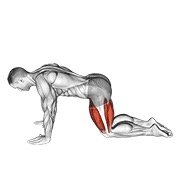 All Fours Squad Stretch
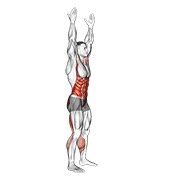 Arms Apart Circular Toe Touch (male)
 Assisted Lying Glutes Stretch
 Assisted Lying Gluteus And Piriformis Stretch
 Assisted Prone Hamstring
 Assisted Prone Lying Quads Stretch
More Glutes Exercises
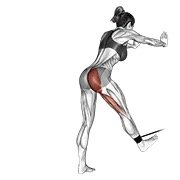 Band Bent-Over Hip Extension
 Band Hip Lift
 Band Lying Hip Internal Rotation
 Band Pull Through
 Band Seated Hip Internal Rotation
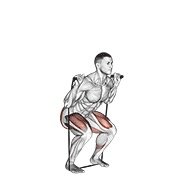 Band Squat
Equipment Alternatives
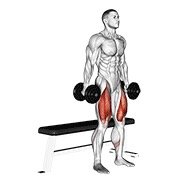
Don't have barbell? These target the same glutes with different equipment.


FAQ
- What muscles does the Barbell Full Squat work?
- The Barbell Full Squat mainly works your glutes. It also helps strengthen your quadriceps and hamstrings, calves, core. Using good, smooth form makes sure you work the right muscles and avoid unnecessary strain on your joints.
- What equipment do I need for the Barbell Full Squat?
- You do the Barbell Full Squat with a barbell. Make sure your equipment is set up safely before starting. If you work out at home or have limited gear, check out our alternative exercises below.
- What form mistake should I watch for on the Barbell Full Squat?
- One mistake to watch for is knee collapse: Keep the knees aligned with the feet to maintain stable tracking.. Use a comfortable range and a controlled return; reduce the load if you cannot maintain the demonstrated setup.
- How many sets and reps should I perform on the Barbell Full Squat?
- To build muscle size, aim for 3 to 4 sets of 8 to 12 reps with 90 to 120 seconds of rest. To build pure strength, focus on 4 to 5 sets of 3 to 6 heavier reps with 2 to 3 minutes of rest.
- What's a good alternative to the Barbell Full Squat?
- The Bodyweight Drop Jump Squat trains your glutes with body weight and a similar movement pattern. Review its form guide before substituting it, since setup and range of motion can differ.